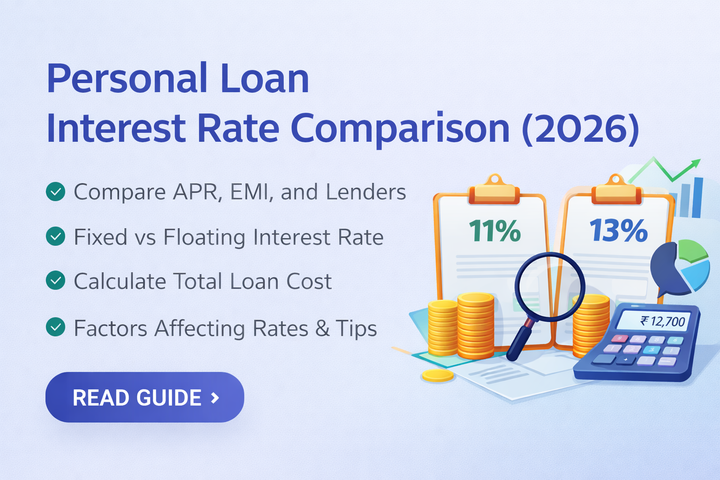
Interest rates on personal loans vary widely across lenders and borrower profiles. Even a small difference in rate can affect total repayment significantly over the life of the loan. That is why comparing personal loan interest rates carefully is essential before committing.
This guide explains how personal loan interest rates work, what influences them, how to compare lenders, current lending trends in 2026, and how to choose the most suitable option based on your financial behavior and goals.
How Personal Loan Interest Rates Work
The interest rate is the cost of borrowing money, expressed annually. Most lenders quote an Annual Percentage Rate (APR), which may include interest plus certain fees, giving a broader picture of total cost.
Interest rates are influenced by:
Two individuals applying for the same loan amount may receive different offers depending on these factors.
Types of Personal Loan Interest Rates
Understanding rate structures helps you compare offers properly.
1. Fixed Interest Rate
The interest rate remains the same throughout the loan tenure.
Benefits
Limitations
2. Floating (Variable) Interest Rate
The rate fluctuates based on benchmark rates set by financial authorities or internal bank benchmarks.
Benefits
Limitations
3. Risk-Based Pricing
In 2026, many lenders use dynamic pricing models. Borrowers with strong credit profiles receive lower rates, while higher-risk profiles may receive higher rates.
Benefits of Personal Loans
-
No collateral required in most cases
-
Quick digital application and approval
-
Flexible usage
-
Fixed repayment schedule
-
Useful for debt consolidation
Personal loans can be a practical solution when managed responsibly.
Limitations to Consider
-
Higher rates compared to secured loans
-
Processing and administrative fees
-
Penalties for late payments
-
Risk of over-borrowing
Understanding these limitations helps prevent financial stress.
Key Features to Compare Before Choosing
When comparing personal loan offers, review more than just the interest rate.
| Feature | Why It Matters | What to Review |
|---|
| Interest Rate Type | Affects EMI stability | Fixed or floating |
| APR | Reflects total borrowing cost | Includes fees |
| Processing Fee | Adds to total expense | Percentage or flat fee |
| Prepayment Charges | Flexibility to close early | Allowed or restricted |
| Loan Tenure | Impacts EMI and total interest | Short vs long tenure |
| EMI Amount | Monthly affordability | Fits budget comfortably |
| Late Payment Charges | Financial risk | Penalty structure |
| Disbursement Speed | Urgency | Processing timeline |
Comparing these features side-by-side gives a clearer financial picture.
Latest Trends in Personal Loan Lending (2026)
1. Fully Digital Processing
Many banks and fintech platforms offer complete online application journeys.
2. AI-Based Credit Assessment
Lenders increasingly use transaction behavior, not just credit score.
3. Pre-Approved Offers
Existing customers often receive instant pre-qualified offers.
4. Flexible EMI Options
Some lenders allow customized repayment structures.
5. Improved Transparency
Comparison tools and digital dashboards provide clearer breakdowns of total repayment.
While these innovations improve access, borrowers should still evaluate terms carefully.
Comparing Loan Tenure: Short vs Long
Loan tenure significantly impacts total repayment.
-
Short tenure → Higher EMI, lower total interest
-
Long tenure → Lower EMI, higher total interest
Conceptual Comparison
| Tenure | EMI Level | Total Interest Paid |
|---|
| Short | Higher | Lower |
| Long | Lower | Higher |
A longer tenure reduces monthly burden but increases overall interest paid. Balance affordability with total cost.
Major Lenders Offering Personal Loans
Several established banks and digital lenders offer personal loans. Terms vary depending on borrower profile.
Examples include:
-
HDFC Bank
-
ICICI Bank
-
State Bank of India
-
Axis Bank
-
Kotak Mahindra Bank
-
Bajaj Finserv
-
Tata Capital
-
MoneyTap
-
PaySense
Comparing multiple lenders improves your chances of finding a suitable rate and structure.
How to Choose the Right Personal Loan
Follow a structured decision process:
Step 1: Define the Purpose Clearly
Avoid borrowing without a specific reason.
Step 2: Assess Repayment Capacity
Ensure EMI does not strain monthly income.
Step 3: Compare Multiple Lenders
Do not rely on a single offer.
Step 4: Evaluate Total Repayment
Focus on total payable amount, not just EMI.
Step 5: Review Fine Print
Check charges, penalties, and clauses.
Step 6: Avoid Multiple Hard Applications
Too many applications may affect credit score.
Buyer Behavior Considerations
Before applying, reflect on:
-
Is this expense necessary?
-
Can I repay without affecting savings?
-
Do I have emergency funds?
-
Am I consolidating high-interest debt effectively?
Borrowing should align with financial stability, not emotional decision-making.
Common Mistakes to Avoid
-
Borrowing more than required
-
Ignoring processing fees
-
Choosing longest tenure without cost comparison
-
Missing EMI payments
-
Overlooking prepayment charges
Small oversights can increase repayment burden significantly.
Comparing Personal Loans with Alternatives
| Option | Collateral Required | Flexibility | Risk Level |
|---|
| Personal Loan | No | High | Moderate |
| Credit Card EMI | No | Medium | Higher interest risk |
| Secured Loan | Yes | Moderate | Lower interest |
| Line of Credit | Usually No | Flexible | Variable |
Sometimes alternatives may offer lower cost depending on the situation.
Practical Checklist Before Applying
-
Credit score checked
-
Income stability confirmed
-
EMI within manageable range
-
Total repayment calculated
-
Fees reviewed
-
Emergency savings maintained
-
Loan agreement read carefully
Use this checklist before finalizing.
Tips for Managing Your Loan Responsibly
-
Set auto-debit for EMI payments
-
Track outstanding balance
-
Consider partial prepayment if allowed
-
Avoid taking additional debt simultaneously
-
Maintain an emergency fund
Responsible management strengthens your credit profile.
Frequently Asked Questions
What credit score is generally required?
Higher credit scores typically qualify for better rates, though criteria vary by lender.
Is a lower EMI always better?
Not necessarily. Lower EMI often means longer tenure and higher total interest.
Can I transfer my loan to another lender?
Some lenders offer balance transfer options subject to eligibility.
Does checking eligibility affect credit score?
Soft eligibility checks usually do not. Hard credit inquiries may.
Fixed or floating rate: which is safer?
Fixed rates provide stability. Floating rates may benefit borrowers if market rates decline.
Is prepayment advisable?
If charges are minimal and funds are available, it may reduce total interest.
Conclusion
Personal loan interest rate comparison in 2026 requires careful evaluation beyond headline percentages. Borrowers should compare APR, tenure impact, processing fees, flexibility, and overall repayment obligations.
Digital access has simplified borrowing, but thoughtful decision-making remains essential. A personal loan should support financial goals without creating long-term strain.
Before committing, take time to compare offers, calculate total repayment, and ensure the EMI fits comfortably within your monthly income. Responsible borrowing is not about finding the fastest approval, but about choosing the most sustainable option.
A well-evaluated personal loan can serve as a practical financial tool when aligned with disciplined planning and repayment capacity.