Modern Microscopes: Types, Technology and Applications
Microscopes are instruments designed to magnify objects that are too small to be observed clearly by the human eye. Since their early development several centuries ago, microscopes have transformed scientific discovery by revealing microscopic structures, living organisms, cells, tissues, and materials.
Modern microscopes combine optics, digital imaging, advanced sensors, and software-based analysis to provide detailed visual information. These technologies allow scientists and researchers to study biological samples, industrial materials, electronic components, and nanostructures with remarkable precision.
The need for microscopes emerged from humanity's desire to understand the hidden structures of nature. As science progressed, researchers required better tools to investigate diseases, analyze materials, and explore microscopic environments. Modern microscopy addresses these needs by offering higher resolution, improved accuracy, and enhanced image processing capabilities.
Today, microscopes are used in laboratories, hospitals, educational institutions, manufacturing facilities, environmental research centers, and quality-control departments across many industries.
Main Types of Modern Microscopes
Different microscope technologies are designed for specific applications and observation requirements.
| Microscope Type | Primary Use | Key Feature |
|---|---|---|
| Optical Microscope | Biology and education | Uses visible light |
| Digital Microscope | Research and inspection | Digital image capture |
| Electron Microscope | Nanotechnology and materials science | Extremely high magnification |
| Fluorescence Microscope | Cellular research | Detects fluorescent markers |
| Confocal Microscope | Advanced biological imaging | Produces detailed 3D images |
| Stereo Microscope | Industrial inspection | Three-dimensional viewing |
| Scanning Probe Microscope | Surface analysis | Atomic-level examination |
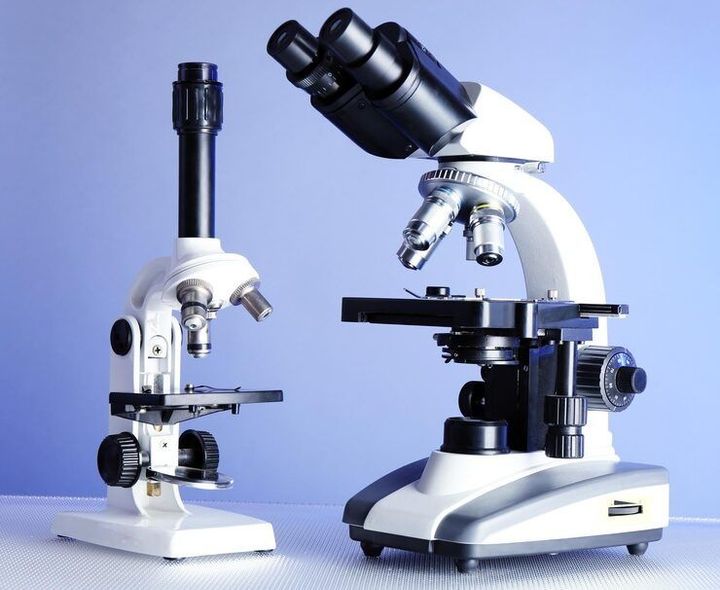
Optical microscopes remain among the most widely used instruments because they provide reliable imaging for educational, medical, and laboratory purposes.
Digital microscopes have become increasingly popular because they allow image storage, sharing, and analysis through computer systems.
Electron microscopes offer significantly greater magnification and resolution than traditional optical systems, enabling researchers to observe structures at the nanometer scale.
How Modern Microscope Technology Works
Modern microscopy combines several technologies to improve imaging performance.
Key technological components include:
- High-quality optical lenses
- Digital imaging sensors
- Artificial intelligence-assisted image analysis
- Automated focusing systems
- Three-dimensional reconstruction software
- Advanced illumination systems
- Cloud-based data management
The integration of digital imaging allows users to capture, process, and analyze microscopic images more efficiently. Automated measurement tools help researchers reduce manual errors and improve consistency across experiments.
The following chart illustrates the relative capabilities of common microscope technologies.
| Technology | Magnification Level | Typical Applications |
| Optical | Moderate | Education, biology |
| Digital | Moderate to high | Inspection, documentation |
| Fluorescence | High | Cellular analysis |
| Confocal | High | 3D biological imaging |
| Electron | Extremely high | Nanotechnology, materials science |
As computing power continues to improve, microscope systems increasingly rely on software-driven enhancements that help researchers identify patterns and perform complex analyses.
Why Modern Microscopes Matter Today
Microscopes play a critical role in advancing scientific understanding and supporting technological innovation.
In healthcare, microscopes help medical professionals examine blood samples, tissues, microorganisms, and cellular structures. Accurate microscopic analysis contributes to disease detection, medical research, and laboratory investigations.
In education, students gain practical experience by observing biological specimens and learning about scientific principles through direct visual observation.
Manufacturing industries use microscopes for quality assurance, defect detection, and material evaluation. Microscopic inspection helps ensure that products meet required standards and specifications.
Environmental researchers use microscopy to study microorganisms, water quality, soil composition, and ecological systems.
The impact of modern microscopy extends to numerous fields, including:
- Life sciences
- Biotechnology
- Materials engineering
- Electronics manufacturing
- Pharmaceutical research
- Environmental science
- Nanotechnology
- Academic education
Without microscopy, many scientific discoveries and technological developments would be significantly more difficult to achieve.
Problems Modern Microscopes Help Solve
Modern microscopes assist in solving a wide range of scientific and industrial challenges.
Some examples include:
- Identifying microscopic contaminants
- Examining cellular abnormalities
- Detecting material defects
- Studying infectious microorganisms
- Analyzing semiconductor components
- Investigating environmental samples
- Supporting product quality assessment
The ability to visualize structures at microscopic and nanoscopic scales provides valuable information that cannot be obtained through standard observation methods.
Recent Updates and Trends in Microscopy
The microscopy field has experienced significant technological progress during 2025 and early 2026.
One major trend is the increasing use of artificial intelligence for image recognition and automated analysis. AI-assisted systems can help researchers process large volumes of imaging data more efficiently and identify microscopic features with greater consistency.
Another important development involves enhanced digital microscopy platforms. Improved imaging sensors and software now support higher-quality image capture, faster processing, and remote collaboration capabilities.
Researchers have also expanded the use of three-dimensional imaging technologies. Advanced confocal and computational microscopy methods continue to improve visualization of biological structures and complex materials.
Recent trends include:
- Greater use of AI-assisted image analysis
- Expansion of cloud-based microscopy platforms
- Improved digital imaging resolution
- Enhanced automation features
- Growth in 3D microscopy applications
- Increased adoption in semiconductor research
- Advances in live-cell imaging techniques
The growing importance of nanotechnology, biotechnology, and advanced manufacturing continues to drive innovation across the microscopy industry.
Emerging Areas of Research
Several research areas are influencing the future of microscopy.
These include:
- Quantum imaging methods
- Automated laboratory workflows
- High-speed microscopic imaging
- Advanced computational microscopy
- Real-time image processing
- Integrated machine learning systems
These developments may further improve imaging accuracy and scientific productivity in the coming years.
Laws, Regulations, and Policy Considerations
Microscopes themselves are generally scientific instruments, but their use is often influenced by regulatory frameworks depending on the industry and country.
Healthcare laboratories must follow established standards for diagnostic testing, sample handling, and equipment validation. Regulatory agencies may require laboratory accreditation and compliance with quality management systems.
Research institutions frequently operate under ethical guidelines and laboratory safety regulations. These rules help ensure responsible scientific practices and proper handling of biological materials.
Manufacturing sectors may use microscopy as part of quality-control procedures governed by industrial standards and certification frameworks.
Common policy areas affecting microscopy applications include:
- Laboratory safety standards
- Medical diagnostic regulations
- Research ethics requirements
- Product quality management systems
- Environmental testing guidelines
- Data protection and documentation policies
Many countries also support scientific research through government-funded innovation programs, academic grants, and technology development initiatives that indirectly encourage advances in microscopy.
Tools and Resources for Learning and Using Microscopy
Many educational and professional resources help users understand microscopy principles and imaging techniques.
Useful resources include:
- Digital image analysis software
- Measurement and calibration tools
- Scientific visualization platforms
- Laboratory documentation templates
- Research databases
- Online microscopy tutorials
- Virtual laboratory simulations
- Educational microscopy guides
- Sample preparation checklists
- Scientific image processing applications
Students and researchers often benefit from online learning platforms that provide interactive lessons on microscope operation, image interpretation, and laboratory best practices.
Image analysis tools can help users measure structures, compare samples, and generate reports for research or educational purposes.
Skills That Support Effective Microscope Use
Several skills contribute to successful microscopy work:
- Sample preparation techniques
- Scientific observation
- Data interpretation
- Image analysis
- Laboratory documentation
- Research methodology
- Quality-control procedures
Developing these skills helps users obtain reliable and meaningful results from microscopic observations.
Frequently Asked Questions
What is the main purpose of a microscope?
A microscope magnifies small objects and structures that cannot be seen clearly with the naked eye, allowing detailed observation and analysis.
What is the difference between an optical microscope and an electron microscope?
An optical microscope uses visible light and lenses, while an electron microscope uses electron beams. Electron microscopes generally provide much higher magnification and resolution.
Where are modern microscopes commonly used?
They are widely used in healthcare laboratories, scientific research institutions, educational facilities, manufacturing industries, environmental studies, and materials science.
How has artificial intelligence influenced microscopy?
Artificial intelligence helps automate image analysis, identify patterns, improve efficiency, and support researchers in processing large amounts of imaging data.
Why is microscopy important in scientific research?
Microscopy enables researchers to study cells, microorganisms, materials, and microscopic structures that are essential for scientific discovery and technological advancement.
Conclusion
Modern microscopes have evolved far beyond traditional magnifying instruments. Through the integration of advanced optics, digital imaging, automation, and artificial intelligence, they have become indispensable tools across science, healthcare, education, manufacturing, and research.