Industrial Automation Explained: Systems, Technologies, Applications, and Future Trends
Industrial automation has become an important part of modern manufacturing, helping industries manage production processes through machines, control systems, sensors, software, and robotics. From automotive assembly lines to food processing plants, automated technologies support repetitive operations, improve process consistency, and provide better visibility into equipment performance. The level of automation varies according to the production requirements, technical infrastructure, and safety considerations of each facility.
The development of industrial automation is closely connected with advances in electronics, computer technology, communication networks, and industrial software. Traditional mechanical equipment can now work alongside programmable logic controllers, supervisory control systems, industrial robots, and connected monitoring platforms. Understanding these technologies helps readers explore how modern factories operate and how automation contributes to manufacturing efficiency, product quality, and industrial development.
What Is Industrial Automation?
Industrial automation is the use of control systems, programmable equipment, software, and mechanical technologies to operate industrial processes with reduced direct human intervention. These systems can monitor operating conditions, process information, and control machinery according to predefined instructions. Depending on the application, automation may manage a single machine, an assembly line, or several connected production processes.
For example, an automated packaging line may use sensors to detect products, a programmable logic controller to coordinate machine movements, and actuators to operate filling or sealing equipment. An operator can monitor the process through a human-machine interface and respond when the system identifies an abnormal condition. This combination of sensing, control, and monitoring forms the foundation of many industrial automation systems.
How Does Industrial Automation Work?
Sensors and Data Collection
Sensors collect information about physical conditions within a machine or production environment. Common examples include temperature sensors, pressure transmitters, proximity sensors, level sensors, flow meters, and optical sensors. The collected information helps the control system determine whether equipment is operating within its defined limits.
Controllers and Automated Decisions
A programmable logic controller, commonly known as a PLC, receives input signals and executes programmed instructions. Based on the control logic, it can activate motors, operate valves, coordinate conveyors, or stop machinery when specific conditions are detected. PLC programming is widely used in industrial control because it supports repeatable machine operation and structured troubleshooting.
Actuators and Machine Operation
Actuators convert control signals into physical movement or action. Electric motors, pneumatic cylinders, hydraulic actuators, and control valves are common examples. When the controller sends an appropriate signal, these devices perform the required task, such as moving a component, opening a valve, or positioning a machine tool.
Monitoring and Feedback
Human-machine interface (HMI) screens and supervisory control and data acquisition (SCADA) systems provide information about equipment status, process conditions, alarms, and production trends. Feedback from sensors allows the system to compare actual operating conditions with target values. This information can help operators identify irregularities and make informed decisions about production and maintenance.
Types of Industrial Automation Systems
Fixed Automation
Fixed automation is designed for a specific sequence of operations that changes very little over time. It is commonly associated with high-volume production lines, specialized assembly equipment, and repetitive manufacturing processes. Its main characteristics include consistent operation and a clearly defined production sequence, although significant product changes may require substantial equipment modifications.
Programmable Automation
Programmable automation allows control instructions to be modified for different products, batches, or production requirements. Manufacturers can adjust machine sequences and operating parameters without redesigning the entire production system. This approach is useful in industries where production schedules or product specifications change periodically.
Flexible Automation
Flexible automation enables equipment to accommodate product variations with limited interruption. Programmable controllers, industrial robots, and configurable manufacturing equipment can support different production tasks within the same facility. Its usefulness depends on system integration, programming, tooling, and the complexity of the products being manufactured.
Integrated Automation
Integrated automation connects different machines, control systems, and production information platforms into a coordinated environment. It may include PLCs, SCADA, manufacturing execution systems, industrial networks, and enterprise software. The goal is to improve communication between production activities and provide a more complete view of manufacturing operations.
Main Components of Industrial Automation
Programmable Logic Controllers
PLCs are industrial computers designed to control machinery and processes. They receive signals from field devices, execute control programs, and send commands to connected equipment. Their role is particularly important in machine sequencing, conveyor control, packaging systems, and other applications requiring reliable and repeatable operations.
SCADA Systems
SCADA systems support supervisory monitoring and data collection across industrial processes. They can display operating conditions, record historical information, manage alarms, and provide an overview of equipment distributed throughout a facility. SCADA is frequently used in manufacturing, water treatment, energy infrastructure, and process industries.
Human-Machine Interfaces
An HMI provides a visual connection between operators and an automated system. Through display screens, operators can observe machine status, review alarms, and adjust permitted operating parameters. A well-designed interface helps present technical information in a format that is easier to understand during routine operation.
Industrial Robots
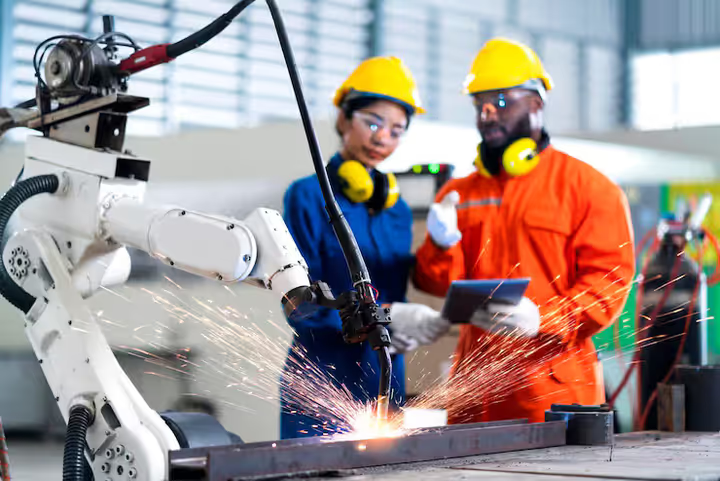
Industrial robots perform tasks such as welding, assembly, painting, material handling, and palletizing. Their movements can be programmed to follow defined paths and repeat operations with consistency. Robot selection depends on factors such as payload, reach, accuracy, operating environment, and the safety requirements of the application.
Sensors, Actuators, and Drives
Sensors measure process conditions, actuators carry out physical actions, and motor drives regulate the speed or torque of compatible motors. These components work together to support automatic machine control. Their performance and compatibility are important considerations when designing or upgrading an industrial automation system.
Industrial Automation Software
Industrial automation software is used to program controllers, configure monitoring interfaces, visualize production processes, and analyze operational data. Depending on the system, it may also connect factory equipment with manufacturing execution systems, maintenance platforms, or enterprise resource planning software. Effective integration can improve information sharing across production and management teams.
Applications of Industrial Automation Across Industries
Automotive Manufacturing
Automotive plants use automation for welding, painting, assembly, component handling, and quality inspection. Robots and programmable controllers coordinate production activities, while sensors help verify part positioning and process conditions. Automated inspection can also identify certain defects before products move to the next manufacturing stage.
Food and Beverage Processing
Food processing facilities use automated systems for mixing, temperature control, filling, packaging, labeling, and material movement. Monitoring helps maintain process parameters and supports consistent production practices. Equipment design must also account for hygiene, cleaning procedures, product characteristics, and applicable food safety requirements.
Pharmaceutical Manufacturing
Pharmaceutical production may use automation to control mixing, environmental conditions, filling, packaging, and equipment monitoring. Electronic records and process monitoring can support traceability and documentation when systems are appropriately designed and validated. Regulatory requirements vary according to the product, process, and jurisdiction.
Chemical and Process Industries
Chemical plants and other process industries rely on instrumentation, process control systems, and safety-related equipment to manage temperature, pressure, flow, and chemical reactions. Automated monitoring can help operators detect abnormal conditions and maintain defined operating parameters. Safety systems must be designed, tested, and maintained according to the risks of the specific process.
Warehousing and Material Handling
Automated conveyors, barcode readers, robotic handling equipment, and warehouse control software help coordinate the movement of materials. These technologies can improve inventory visibility and reduce repetitive handling activities. Their effectiveness depends on facility layout, product characteristics, integration, and the reliability of the supporting systems.
Benefits of Industrial Automation
Improved Productivity and Consistency
Automated machinery can perform repetitive operations at controlled speeds and repeat programmed sequences. This can help maintain consistent production output and reduce variation caused by differences in manual execution. Actual productivity improvements depend on equipment availability, process design, maintenance, and production planning.
Quality Control and Reduced Waste
Automated inspection systems can measure dimensions, identify certain surface defects, and check whether products meet defined specifications. Process monitoring can also reveal conditions associated with quality problems. These capabilities can support better quality control, although inspection systems must be properly configured and validated for the task.
Workplace Safety
Automation can reduce the need for workers to perform some hazardous, repetitive, or physically demanding tasks directly. Robots, remote monitoring, machine guarding, and interlocking systems can contribute to safer working environments when implemented correctly. Automation does not remove every workplace risk, so training, risk assessment, and appropriate safety procedures remain necessary.
Equipment Monitoring and Maintenance Planning
Industrial sensors and monitoring platforms can provide information about vibration, temperature, operating cycles, and other equipment conditions. When this information is analyzed over time, it may help maintenance teams identify developing problems and plan inspections. Predictive maintenance results depend on data quality, analytical methods, equipment characteristics, and the availability of appropriate maintenance expertise.
Energy and Resource Management
Automation can help monitor electricity use, compressed air, water consumption, material flow, and production waste. Operators can use these measurements to identify inefficient operating patterns and evaluate possible improvements. Energy savings are not automatic; they depend on equipment selection, control strategies, operating schedules, and ongoing optimization.
Industrial Internet of Things and Industry 4.0
Connected Industrial Equipment
The Industrial Internet of Things (IIoT) connects industrial equipment, sensors, and software platforms so that operating data can be collected and shared. Connected systems can help organizations compare equipment performance, review production trends, and monitor assets across multiple locations. Communication standards and compatible interfaces are important for reliable integration.
Artificial Intelligence in Manufacturing
Artificial intelligence can be applied to visual inspection, anomaly detection, process analysis, and maintenance planning. Machine learning models may identify patterns in historical or real-time data that are difficult to detect through simple rules alone. These systems require suitable data, testing, human oversight, and ongoing evaluation to ensure that their outputs remain useful.
Digital Twins and Smart Manufacturing
A digital twin is a digital representation of a physical asset, process, or system that can be used for monitoring, simulation, or analysis. Depending on its design, it may help engineers examine operating scenarios, study process changes, and understand equipment behavior. Smart manufacturing combines connected technologies, automation, and operational data to support more informed production decisions.
Challenges in Industrial Automation
Initial Investment and System Integration
Automation projects may involve controllers, sensors, robots, software, engineering, installation, and staff training. Integrating new equipment with older machinery can also introduce compatibility challenges. A clear assessment of production requirements and existing infrastructure helps organizations understand the technical scope of a project.
Cybersecurity and Data Protection
Connected industrial systems may be exposed to cybersecurity risks if networks, devices, and access controls are not adequately protected. Industrial cybersecurity practices can include network segmentation, access management, secure configuration, backups, patch planning, and incident response procedures. Security measures must be selected carefully because changes to operational technology can affect production and safety.
Skills and Workforce Training
Industrial automation requires knowledge of control systems, electrical equipment, programming, instrumentation, networking, and troubleshooting. Workers may need training to operate and maintain new technologies effectively. Collaboration between operators, engineers, technicians, and safety professionals can support reliable implementation.
Maintenance and Reliability
Automated systems still require inspection, calibration, software management, and preventive maintenance. A fault in a sensor, controller, communication network, or mechanical component can interrupt production. Maintenance planning and appropriate spare-parts management can help reduce the impact of equipment failures.
Future Trends in Industrial Automation
Industrial automation is developing through advances in robotics, machine vision, connected sensors, edge computing, AI-based analytics, and digital simulation. Collaborative robots are designed to support certain tasks alongside people, subject to suitable risk assessment and protective measures. More connected manufacturing systems are also creating opportunities for real-time monitoring and data-driven process improvement.
Another important trend is the integration of operational technology with business information systems. This can provide a broader view of production schedules, machine performance, inventory, and quality information. As these systems become more connected, interoperability, cybersecurity, workforce skills, and responsible data management will remain important considerations.
Frequently Asked Questions About Industrial Automation
What is industrial automation in simple terms?
Industrial automation uses machines, sensors, controllers, and software to operate industrial processes with reduced direct human involvement. It helps coordinate repetitive tasks and monitor production conditions.
What are the four main types of industrial automation?
The commonly described categories are fixed automation, programmable automation, flexible automation, and integrated automation. Each supports different production volumes, levels of product variation, and system integration requirements.
What is the difference between PLC and SCADA?
A PLC primarily executes control logic for machinery and industrial processes. SCADA provides supervisory monitoring, data collection, alarms, and visualization across one or more systems.
Which industries use industrial automation?
Industrial automation is used in automotive manufacturing, food processing, pharmaceuticals, chemicals, electronics, energy, water treatment, logistics, and many other sectors.
How does industrial automation support predictive maintenance?
Connected sensors can collect information about equipment conditions, such as vibration and temperature. Analyzing this data may help maintenance teams recognize abnormal patterns and schedule inspections before certain failures occur.
What is the role of IIoT in industrial automation?
IIoT connects industrial devices and systems to support data collection, remote monitoring, analytics, and communication between equipment and software platforms.
Conclusion
Industrial automation combines control systems, sensors, actuators, robotics, industrial software, and communication networks to manage manufacturing and process operations. Its applications extend from individual machines to integrated production facilities, where monitoring and coordinated control can support productivity, quality, safety, and resource management.
Technologies such as PLCs, SCADA, industrial robotics, IIoT, and artificial intelligence continue to expand the capabilities of automated production. However, successful implementation requires careful planning, suitable equipment, cybersecurity, maintenance, and workforce training. Understanding these fundamentals provides a useful starting point for exploring the role of industrial automation in modern manufacturing and industrial development.