Induction Sealing Machines: Complete Guide to Packaging Technology
Induction sealing machines are advanced packaging systems used to create airtight and tamper-evident seals on containers. They work by using electromagnetic induction to heat a metallic foil liner placed inside a cap, which then bonds with the container’s opening.
This technology is widely used in industries where product safety, freshness, and contamination prevention are essential. It is commonly found in food packaging, pharmaceuticals, chemicals, cosmetics, and agrochemical packaging lines.
The primary purpose of induction sealing is to ensure product integrity from production to end-user consumption. It also helps improve shelf life and reduces leakage risks during transportation and storage.
How Induction Sealing Technology Works
Induction sealing machines operate through a controlled electromagnetic field that generates heat in a conductive foil liner. This heat activates a sealing layer, bonding it to the container rim.
Key Process Steps
- A filled container is capped with a foil-lined closure
- The container passes under an induction sealing head
- Electromagnetic energy is emitted from the coil
- The foil liner heats up due to induced current
- The sealing layer melts and bonds to the container mouth
- Cooling creates a secure, airtight seal
This process is non-contact, meaning the machine does not physically touch the container during sealing, which reduces contamination risks and improves production hygiene standards.
Structural Components and System Design
Induction sealing machines are built with multiple precision components that ensure consistent sealing quality.
Major Components
- Induction coil head for electromagnetic generation
- Power control unit for regulating energy output
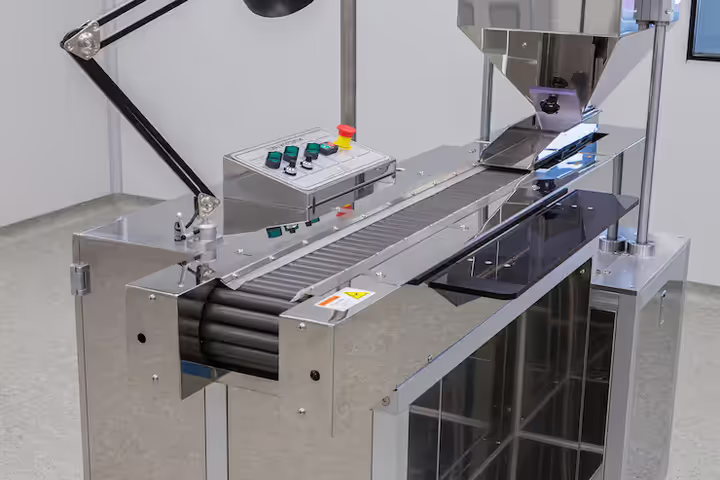
- Conveyor system for continuous production lines
- Cooling system for stabilizing sealed containers
- Control panel for parameter adjustment
- Sensor system for container detection and alignment
Each component plays a role in maintaining sealing accuracy, production speed, and operational safety in industrial environments.
Types of Induction Sealing Machines
Different industries require different sealing setups depending on production scale and container type.
Common Machine Types
- Handheld induction sealers for small-scale operations
- Semi-automatic sealing machines for medium production units
- Fully automatic inline sealing systems for large manufacturing plants
- Water-cooled induction systems for high-speed production lines
- Air-cooled compact sealing units for flexible packaging setups
These variations allow manufacturers to choose systems based on production volume, packaging material, and automation needs.
Industrial Applications and Use Cases
Induction sealing machines are widely used across multiple industries due to their reliability and efficiency.
Key Application Areas
- Food and beverage packaging for sauces, oils, and dairy products
- Pharmaceutical packaging for syrups, tablets, and liquid medicines
- Chemical industry for solvents, cleaners, and reagents
- Cosmetic products like creams, lotions, and shampoos
- Agricultural chemicals including fertilizers and pesticides
In each of these sectors, sealing integrity is critical for safety, compliance, and customer trust
Importance in Modern Packaging Systems
Induction sealing technology plays a major role in modern industrial packaging due to its ability to enhance product protection and operational efficiency.
It solves several common packaging challenges:
- Prevents leakage during transportation
- Reduces contamination risks
- Ensures tamper evidence for consumer safety
- Extends product shelf stability
- Supports high-speed automated production lines
As industries move toward automation and quality assurance systems, induction sealing has become an essential part of packaging infrastructure.
Key Features of Induction Sealing Systems
Functional Features
- Non-contact sealing method
- High-speed continuous operation
- Adjustable power control systems
- Compatibility with multiple container materials
- Consistent sealing quality across batches
Operational Advantages
- Low maintenance requirements
- Integration with automated production lines
- Energy-efficient operation systems
- Suitable for different container shapes and sizes
Recent Trends and Technological Developments (2025 Updates)
In 2025, induction sealing systems have seen significant advancements focused on automation, efficiency, and smart manufacturing integration.
Notable Developments
- Integration of IoT-based monitoring systems for real-time performance tracking (early 2025)
- AI-assisted defect detection systems improving sealing accuracy (mid 2025)
- Energy-efficient induction coils designed to reduce power consumption
- Smart conveyor synchronization systems improving production flow
- Enhanced compatibility with recyclable and eco-friendly packaging materials
Manufacturers are increasingly adopting Industry 4.0 frameworks, where induction sealing machines are connected to centralized production management systems for predictive maintenance and optimization.
Regulations and Compliance Standards
Induction sealing machines are often used in regulated industries, especially pharmaceuticals and food processing. Therefore, compliance with packaging standards is important.
Relevant Compliance Areas
- Food safety packaging regulations ensuring contamination prevention
- Pharmaceutical packaging standards requiring tamper-evident sealing
- Chemical handling safety guidelines for hazardous materials
- Industrial manufacturing quality control frameworks such as ISO-based systems
These standards ensure that sealed products remain safe, traceable, and compliant throughout the supply chain.
Useful Tools, Systems, and Learning Resources
Industry Tools and Platforms
- Packaging line automation controllers
- Industrial induction power monitoring systems
- Quality inspection systems for seal integrity testing
- Conveyor integration software for production optimization
Learning Resources
- Packaging engineering courses from technical institutes
- Industrial automation training modules
- Manufacturing technology journals and publications
- Online industrial machinery simulation platforms
These resources help engineers and technicians understand both operational and design aspects of induction sealing systems.
Comparison of Induction Sealing Machine Types
| Machine Type | Production Capacity | Automation Level | Primary Usage |
|---|---|---|---|
| Handheld Sealer | Low | Manual | Small batches, lab use |
| Semi-Automatic | Medium | Partial automation | Small factories |
| Inline System | High | Fully automated | Large-scale production |
| Water-Cooled System | Very High | Advanced automation | Continuous industrial lines |
| Air-Cooled Unit | Medium | Flexible automation | Multi-product facilities |
Frequently Asked Questions
What is the main purpose of induction sealing machines?
The main purpose is to create airtight and tamper-evident seals on containers to protect product integrity and prevent leakage or contamination.
Which industries commonly use induction sealing technology?
It is widely used in food processing, pharmaceuticals, cosmetics, chemicals, and agricultural packaging industries.
Does induction sealing require physical contact with containers?
No, it uses electromagnetic induction, meaning the sealing process is completely non-contact.
Can induction sealing machines handle different container materials?
Yes, they are compatible with multiple container types, including plastic and glass, depending on liner design.
Is induction sealing suitable for automated production lines?
Yes, modern systems are designed for integration into fully automated high-speed production environments.
Conclusion
Induction sealing machines represent a critical advancement in modern packaging technology. By using electromagnetic induction to create secure seals, they ensure product safety, extend shelf life, and improve production efficiency across multiple industries.
With increasing automation, digital monitoring, and sustainable packaging trends emerging in 2025, these systems continue to evolve as essential components in industrial manufacturing environments. Their adaptability, reliability, and compatibility with modern production systems make them a key solution for advanced packaging requirements.