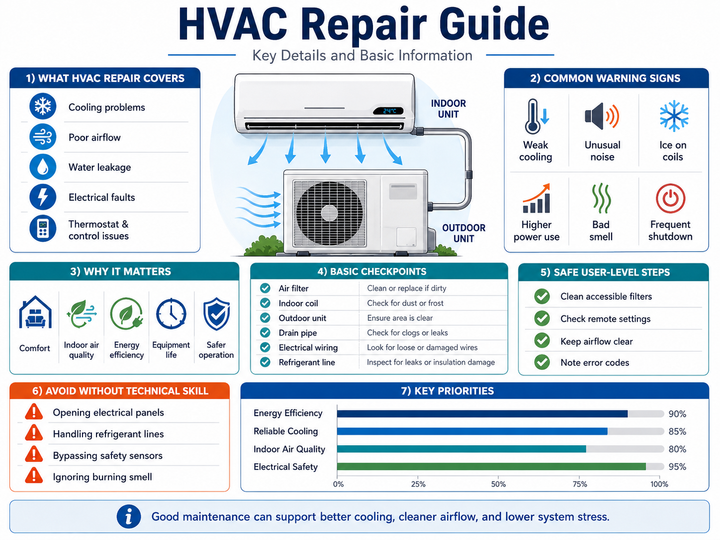
HVAC Repair Guide: Key Details and Basic Information
HVAC means heating, ventilation, and air conditioning. An HVAC system helps control indoor temperature, airflow, humidity, and air quality. In India, most people use the term mainly for air conditioners, central cooling systems, ducted units, chillers, ventilation systems, and commercial cooling equipment.
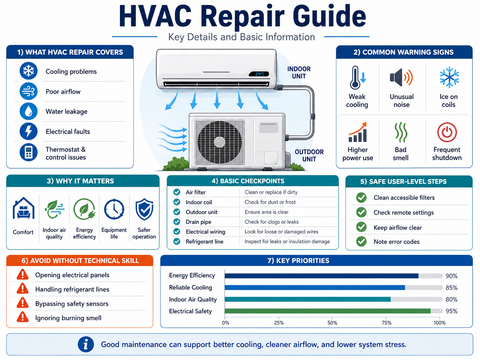
HVAC repair refers to identifying and correcting problems in these systems. Common issues include weak cooling, unusual noise, water leakage, electrical faults, poor airflow, frozen coils, thermostat errors, refrigerant leakage, compressor failure, and high electricity use.
HVAC systems exist because indoor comfort has become important for homes, apartments, offices, hospitals, retail spaces, schools, factories, data centers, and public buildings. In hot and humid regions, cooling is not only about comfort. It also supports productivity, health, equipment protection, and safe indoor conditions.
A properly maintained HVAC system helps:
- Maintain comfortable indoor temperature
- Improve airflow and ventilation
- Reduce humidity-related problems
- Support indoor air quality
- Protect electrical and mechanical parts
- Reduce unnecessary electricity consumption
- Extend equipment life
- Lower the risk of sudden breakdowns
HVAC repair should be seen as a technical inspection and correction process. It is not only about fixing a non-working unit. It also includes preventive checks that help detect early signs of system stress.
Why HVAC Repair Exists
HVAC systems work under constant load. In Indian cities, air conditioners often run for long hours during summer and humid months. Dust, pollution, voltage fluctuations, blocked filters, incorrect installation, poor drainage, and refrigerant issues can reduce performance over time.
A cooling unit may appear normal from the outside, but internal parts can gradually lose efficiency. The coil may become dirty, the filter may restrict airflow, the drain pipe may clog, or the refrigerant level may become low. These problems can make the system consume more electricity while cooling less effectively.
The basic purpose of HVAC repair is to restore safe and efficient operation.
| Common HVAC Issue | Possible Cause | Practical Impact |
|---|---|---|
| Weak cooling | Dirty filter, low refrigerant, coil blockage | Longer cooling time |
| Water leakage | Blocked drain pipe or incorrect slope | Wall dampness or floor leakage |
| High electricity use | Poor airflow, compressor stress, old parts | Higher power consumption |
| Unusual noise | Fan motor, loose part, bearing wear | Mechanical stress |
| Bad smell | Moisture, dust, microbial buildup | Poor indoor experience |
| Frequent shutdown | Electrical fault or sensor issue | Unstable operation |
| Ice formation | Low refrigerant or airflow restriction | Cooling failure risk |
Why HVAC Repair Matters Today
HVAC repair matters more today because cooling demand is rising across India. Urbanization, hotter summers, dense housing, commercial buildings, and digital infrastructure have increased dependence on air conditioning and ventilation systems.
India’s HVAC market is expected to reach USD 12.14 billion in 2025 and grow to USD 17.41 billion by 2030, according to a 2025 market estimate. This reflects wider adoption of cooling systems across residential, commercial, and industrial spaces.
This topic affects:
- Homeowners using split or window AC units
- Apartment residents with limited ventilation
- Offices and co-working spaces
- Shops, malls, hotels, and restaurants
- Hospitals and diagnostic centers
- Schools and coaching centers
- Data centers and equipment rooms
- Small businesses using cooling for inventory or customer comfort
HVAC problems can create practical difficulties. Poor cooling affects comfort. Dirty filters may reduce airflow. Water leakage can damage walls. Electrical faults may create safety risks. Poor ventilation may affect indoor air quality. In commercial buildings, HVAC failure can disrupt daily operations.
Indoor air quality is another important reason. A neglected system can circulate dust, allergens, moisture, and odors. Filter cleaning, coil cleaning, drainage checks, and ventilation review can help maintain a healthier indoor environment.
Recent Updates and Trends
HVAC repair and maintenance are becoming more connected with energy efficiency, smart controls, refrigerant transition, and sustainable cooling.
India’s cooling demand is expected to keep rising, and public policy has recognized cooling as an important energy and environmental issue. The India Cooling Action Plan gives a long-term vision for cooling across sectors, including reducing cooling demand, improving energy efficiency, and supporting refrigerant transition by 2037–38.
Refrigerant policy is another key development. India has ratified the Kigali Amendment to the Montreal Protocol. Under this pathway, India will phase down HFC production and consumption in steps from 2032 onward, with reductions of 10% in 2032, 20% in 2037, 30% in 2042, and 85% in 2047. This matters because refrigerants are central to HVAC repair, leakage checks, and future equipment design.
Energy labelling is also becoming more important. The Bureau of Energy Efficiency star rating system helps users understand appliance energy efficiency. For air conditioners, star ratings are linked with efficiency standards and are important when evaluating long-term electricity use. Broader energy-efficiency labelling has also been expanding to more cooling-related equipment.
Another trend is smart HVAC monitoring. Modern systems increasingly use sensors, Wi-Fi control, inverter technology, fault codes, and energy dashboards. These features can help users detect irregular cooling, compressor load, airflow problems, and maintenance needs earlier.
Text graph: Key HVAC priorities in India
Energy Efficiency ██████████
Reliable Cooling ██████████
Refrigerant Safety █████████
Indoor Air Quality ████████
Smart Monitoring ███████
Preventive Maintenance ███████
Electrical Safety ███████
Laws, Policies, and Compliance Context in India
HVAC repair in India is influenced by energy-efficiency rules, environmental policy, refrigerant handling, electrical safety, and building standards.
The India Cooling Action Plan is one of the most important policy references. It aims to reduce cooling demand by 20% to 25%, reduce refrigerant demand by 25% to 30%, and reduce cooling energy requirement by 25% to 40% by 2037–38.
Refrigerants are regulated because some older substances affect the ozone layer or contribute to global warming. India’s HCFC phase-out work is connected with the Montreal Protocol framework. India has obligations to phase out ozone-depleting substances, including HCFCs, according to defined reduction schedules.
For residential users, the practical meaning is simple: refrigerant leakage, refilling, recovery, and disposal should be handled carefully. Incorrect handling can affect cooling performance, equipment safety, and environmental impact.
Electrical safety is also relevant. HVAC units use compressors, capacitors, wiring, circuit breakers, earthing, and high-load electrical connections. Incorrect wiring or weak electrical protection can create risks. Proper installation, stable voltage, and safe circuit capacity are important for reliable operation.
For commercial buildings, HVAC systems may also be linked with:
- Fire safety requirements
- Building ventilation standards
- Indoor air quality planning
- Equipment room access control
- Energy audits
- Maintenance logs
- Refrigerant handling records
- Electrical inspection records
An HVAC system should not be repaired casually if the issue involves refrigerant, electrical components, compressor failure, or internal wiring. Those areas require trained technical handling.
Useful Tools and Resources
Several tools and resources can help users understand HVAC system condition and maintenance needs.
Energy label information
BEE star ratings help users understand energy efficiency levels for air conditioners and other regulated appliances.
Thermometer and humidity meter
These tools help compare room temperature, vent temperature, and humidity levels. They can help identify whether cooling feels weak because of high heat load, poor airflow, or system performance issues.
Air filter checklist
A simple checklist can track filter cleaning frequency, dust buildup, airflow change, and visible dirt.
Maintenance log template
A log can record inspection dates, filter cleaning, drain cleaning, unusual noise, repair notes, part replacement, and refrigerant checks.
Electricity consumption calculator
A unit consumption calculator can help estimate electricity use based on wattage, daily operating hours, and tariff. This is useful when cooling performance is poor and power use appears unusually high.
Room sizing guide
A basic room-size guide can help users understand whether the cooling capacity is suitable for the room. Oversized or undersized units can cause comfort and efficiency issues.
Indoor air quality monitor
Some monitors track dust particles, humidity, temperature, and carbon dioxide. These indicators can help assess whether ventilation needs attention.
HVAC Repair and Maintenance Checklist
| Check Area | What to Observe | Why It Matters |
|---|---|---|
| Air filter | Dust buildup or blockage | Affects airflow and cooling |
| Indoor coil | Dirt or frost | Affects heat exchange |
| Outdoor unit | Blocked airflow or debris | Affects compressor load |
| Drain pipe | Slow drainage or leakage | Prevents water damage |
| Thermostat | Incorrect reading | Affects temperature control |
| Electrical wiring | Loose or burnt marks | Safety concern |
| Refrigerant line | Ice, oil mark, weak cooling | Possible leakage |
| Fan operation | Noise or low airflow | Mechanical issue |
| Remote or control panel | Error codes | Helps identify fault type |
Basic HVAC Troubleshooting Guide
| Symptom | Basic Check | When Technical Help Is Needed |
|---|---|---|
| AC not turning on | Power supply, remote battery, MCB | Repeated tripping or wiring smell |
| Low cooling | Filter, temperature setting, doors/windows | Ice formation or refrigerant suspicion |
| Water leakage | Drain pipe blockage | Leakage from indoor unit continues |
| Loud noise | Loose panel or blocked fan area | Motor or compressor noise |
| Bad smell | Filter and drainage | Mold-like smell persists |
| High power use | Usage hours and filter condition | Cooling remains weak after cleaning |
Practical Safety Points
Users can perform simple visual checks, but should avoid opening sealed components or handling electrical parts without proper knowledge.
Safe user-level checks include:
- Cleaning accessible filters
- Checking remote settings
- Ensuring doors and windows are closed
- Keeping outdoor unit airflow clear
- Checking whether drain water is flowing
- Observing unusual sounds or smells
- Recording error codes shown on the display
Avoid these without technical skill:
- Opening electrical panels
- Touching capacitors or wiring
- Handling refrigerant lines
- Bypassing safety sensors
- Running a unit with burning smell
- Ignoring repeated MCB trips
- Operating the system with visible sparking
FAQs
What is HVAC repair?
HVAC repair means identifying and correcting problems in heating, ventilation, and air conditioning systems. It may involve airflow checks, filter cleaning, drainage correction, electrical inspection, refrigerant diagnosis, or mechanical part review.
Why is my air conditioner cooling less than before?
Common reasons include dirty filters, blocked coils, low refrigerant, poor outdoor-unit airflow, incorrect room sizing, direct sunlight, open doors, or compressor-related issues. If basic cleaning does not help, a technical inspection may be needed.
How often should an HVAC system be checked?
For regular home use, filters should be cleaned more frequently during heavy summer use. A broader inspection before peak summer is helpful. Commercial systems usually need more structured maintenance because they run for longer hours.
Is refrigerant leakage dangerous?
Refrigerant leakage can reduce cooling and may affect system operation. It should be handled by trained technicians because refrigerant recovery, leak detection, and refilling require proper equipment and safety procedures.
Can HVAC maintenance reduce electricity use?
Yes, basic maintenance can support better efficiency. Clean filters, clear coils, proper airflow, correct thermostat settings, and a healthy outdoor unit can reduce unnecessary load on the system.
Conclusion
HVAC repair is an important part of maintaining indoor comfort, energy efficiency, and equipment safety. In India, cooling systems are becoming more important because of rising temperatures, urban growth, and greater use of air conditioning in homes and commercial spaces.
The main purpose of HVAC repair is not only to fix breakdowns. It is also to detect early warning signs, maintain airflow, prevent water leakage, improve cooling performance, support indoor air quality, and reduce unnecessary energy use.
Policy trends such as the India Cooling Action Plan, refrigerant transition, and energy-efficiency labelling show that HVAC systems are now part of a wider sustainability and electricity-demand discussion. A well-maintained HVAC system can provide better comfort, safer operation, and more responsible energy use.
For users, the best approach is simple: keep filters clean, monitor unusual changes, avoid unsafe electrical handling, maintain airflow around the outdoor unit, and use trained technical help for complex issues such as refrigerant leakage, compressor faults, and wiring problems.