Jump to a Chapter

Gold Loan and Personal Loan Guide: Key Details and Basic Information

Gold Loan and Personal Loan Guide: Key Details and Basic Information

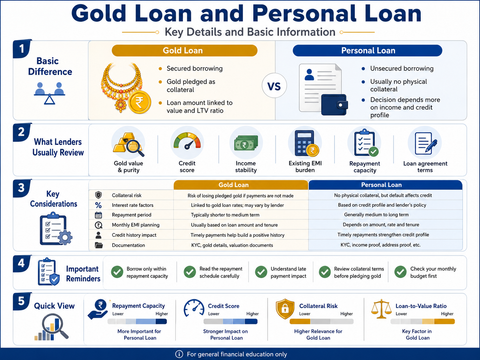
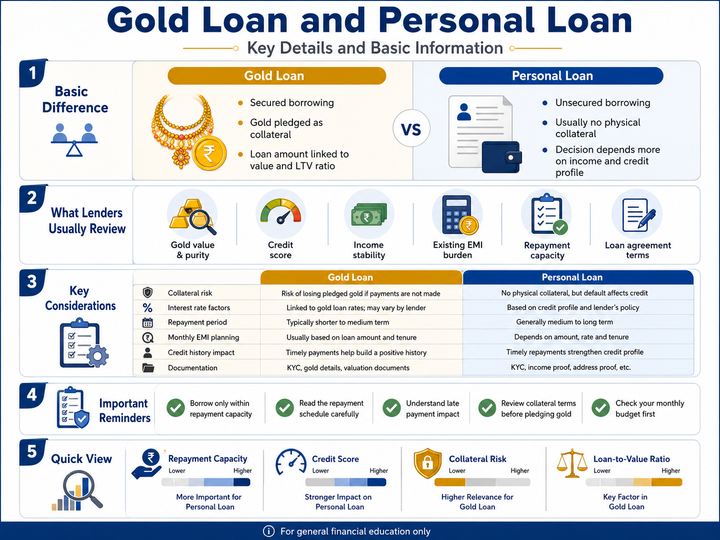
Gold loans and personal loans are two common forms of borrowing used by individuals in India. Both can help people manage planned or unexpected financial needs, but they work in different ways.


A gold loan is generally a secured form of borrowing. This means the borrower pledges gold as collateral. The amount depends on the value, purity, and applicable loan-to-value ratio of the pledged gold. Since an asset is involved, the lender has collateral linked to the repayment agreement.

A personal loan is generally unsecured. This means it usually does not require physical collateral. Instead, the lender reviews income, repayment history, credit score, existing obligations, and financial profile before making a decision.

This article is for general financial education. It explains common differences, terms, and risk factors related to gold loans and personal loans. It does not recommend any lender, financial product, or borrowing decision.

Why Gold Loans and Personal Loans Exist

Borrowing options exist because individuals may face different financial situations. Some people may have gold assets but limited credit history. Others may have a regular income and a strong repayment record but may not want to pledge an asset.

Gold has traditionally been an important household asset in India. Because of this, gold-backed borrowing has become a common way to access liquidity while retaining ownership, subject to repayment terms.

Personal loans exist for borrowers whose eligibility is assessed mainly through income and credit behaviour. These loans are usually linked to repayment ability rather than pledged assets.

Both types of loans create repayment responsibility. The difference is in how risk is handled. In a gold loan, the risk is partly linked to the pledged gold. In a personal loan, the risk is mainly linked to the borrower’s credit profile and repayment discipline.

FactorGold LoanPersonal Loan
Basic typeSecured borrowingUnsecured borrowing
CollateralGold is pledgedUsually no physical collateral
Main review factorGold value and purityIncome and credit profile
Credit score roleMay still matterUsually important
Repayment impactMissed repayment may affect credit recordMissed repayment may affect credit record
Collateral riskPledged gold may be affected after due processNo pledged gold, but recovery action may follow
Common use caseShort-term liquidityPersonal financial requirements
Key term to understandLoan-to-value ratioCredit score and EMI capacity

Why This Topic Matters Today

Understanding the difference between gold loans and personal loans matters because borrowing affects future financial stability. A loan is not only about receiving funds. It also creates a repayment obligation.

This topic affects:

  • Salaried individuals managing monthly EMI planning
  • Self-employed individuals with variable income
  • Families holding gold assets
  • Borrowers with limited credit history
  • Individuals checking CIBIL score or credit report
  • People comparing secured and unsecured borrowing
  • Households managing urgent financial needs
  • Borrowers reviewing repayment discipline

The main purpose of learning about these loan types is to understand financial responsibility. A borrower should know what affects approval, repayment, interest rate, collateral risk, and future credit history.

Important points include:

  • Monthly EMI amount
  • Interest rate type
  • Repayment period
  • Late payment impact
  • Credit score effect
  • Collateral terms
  • Agreement conditions
  • Total repayment obligation
  • Prepayment rules
  • Penalty and recovery clauses

A gold loan may appear simpler when the borrower has gold available as collateral. A personal loan may appear more suitable when the borrower has stable income and a strong credit record. However, neither option should be judged only by convenience. Repayment capacity is the central factor.

Gold Loan Basics

A gold loan is linked to pledged gold. The lender checks purity, weight, and applicable valuation method. Based on that, a loan-to-value ratio is applied.

Loan-to-value ratio, or LTV, means the maximum loan amount allowed against the assessed value of the pledged gold. For example, if gold is assessed at a certain value, the lender does not usually provide the full assessed amount. A regulated limit is applied.

The Reserve Bank of India issued directions on lending against gold and silver collateral on June 6, 2025. These directions are to be complied with no later than April 1, 2026.

The revised framework includes a tiered maximum LTV structure for consumption loans secured against eligible collateral: 85% for loans up to ₹2.5 lakh, 80% for loans above ₹2.5 lakh and up to ₹5 lakh, and 75% for loans above ₹5 lakh.

A gold loan generally involves:

  • Gold purity assessment
  • Weight verification
  • Collateral documentation
  • Loan-to-value calculation
  • Repayment schedule
  • Interest rate terms
  • Pledged gold custody rules
  • Closure and release process
  • Default and auction process

Borrowers should understand that pledged gold is linked to repayment. If repayment is not made as agreed, the lender may follow a defined process that can affect the pledged gold.

Personal Loan Basics

A personal loan is generally unsecured. This means the borrower usually does not pledge gold, property, or another physical asset.

The lender may review:

  • Income level
  • Employment or business stability
  • Existing EMIs
  • Credit score
  • Past repayment record
  • Bank account activity
  • Age and profile
  • Loan amount requested
  • Repayment period

Because there is usually no collateral, credit profile becomes more important. A strong repayment history can support credibility. Delayed payments, high existing debt, or frequent credit inquiries may affect lender assessment.

Personal loans are also closely watched from a regulatory risk perspective because they fall under unsecured retail credit. In November 2023, RBI increased risk weights on consumer credit exposure from 100% to 125%, excluding categories such as housing, education, vehicle, and gold loans. This was part of a broader move to manage risk in fast-growing unsecured credit segments.

In February 2025, RBI partly adjusted some stricter norms for microfinance and certain bank exposure to non-bank lenders, but unsecured credit risk continued to remain an important monitoring area.

Key Differences Explained

AreaGold LoanPersonal Loan
NatureAsset-backed borrowingCredit-profile-based borrowing
CollateralGold requiredUsually not required
Main dependencyGold value and LTVIncome and credit score
Credit score relevanceMay be consideredUsually important
Repayment riskGold collateral may be affectedCredit profile may be affected
DocumentationIdentity, address, gold assessmentIdentity, address, income proof, bank records
Interest rate factorCollateral reduces lender riskUnsecured nature increases lender risk
Review focusGold purity, valuation, ownership detailsRepayment capacity and existing obligations

Financial Planning Factors

Before taking any loan, a borrower should review repayment ability. Borrowing should not be based only on availability. It should be based on whether repayment can be managed without disturbing essential expenses.

A practical financial review can include:

  • Monthly income
  • Existing EMIs
  • Household expenses
  • Emergency savings
  • Loan repayment period
  • Interest rate type
  • Total repayment amount
  • Late payment terms
  • Collateral risk
  • Credit score effect

A borrower should avoid over-borrowing. Even when approval appears possible, repayment pressure can affect household finances.

EMI Planning Table

Monthly FactorWhy It Matters
Income stabilityHelps assess repayment comfort
Existing EMIsShows current debt burden
Essential expensesProtects basic monthly needs
Emergency reserveHelps manage unexpected events
Loan periodAffects EMI size and total repayment
Interest rateAffects monthly repayment
Late payment termsImportant for risk awareness
Credit score impactAffects future borrowing ability

Repayment Responsibility Graph

Relative importance of common borrowing factors:

Repayment Capacity ██████████
Credit Score █████████
Interest Rate █████████
Loan-to-Value Ratio ████████
Collateral Risk ████████
Existing EMI Burden ███████
Agreement Terms ███████
Documentation Accuracy ██████

Recent Policy and Market Context

Gold-backed borrowing has gained attention because gold prices and household gold holdings play an important role in India’s financial behaviour. As a result, regulators have focused on valuation standards, loan-to-value limits, and borrower protection.

The RBI’s 2025 gold and silver collateral directions aim to create a more harmonized framework across regulated entities. Important areas include valuation, LTV maintenance, collateral custody, borrower communication, and default-related process.

For personal loans, the broader regulatory concern is unsecured credit expansion. Since no physical collateral is generally pledged, lenders need to assess repayment ability carefully. This is why credit score, income, and existing debt obligations remain important.

India’s Digital Personal Data Protection Rules, 2025 are also relevant. Financial institutions often process personal data such as identity details, contact information, income data, credit records, and bank information. The DPDP Rules, 2025 were notified with phased implementation timelines, including provisions related to notice, consent, data protection duties, and user rights.

For borrowers, this means financial documents and personal information should be shared carefully. Loan-related data should be provided only through legitimate, secure, and verified channels.

Laws and Policy Areas in India

Gold loans and personal loans are influenced by several areas of financial regulation and documentation.

Important policy-linked areas include:

  • RBI rules for regulated lenders
  • Gold collateral valuation norms
  • Loan-to-value ratio limits
  • Credit bureau reporting
  • Fair lending documentation
  • Penal charge disclosure
  • Recovery communication norms
  • Data privacy obligations
  • Digital consent and identity verification
  • Loan agreement transparency

A loan agreement should be read before acceptance. Borrowers should review interest rate, repayment schedule, late payment charges, prepayment terms, collateral clauses, recovery process, and data usage terms.

For gold loans, the borrower should clearly understand how pledged gold will be stored, valued, released, or handled in case of non-payment.

For personal loans, the borrower should clearly understand how repayment history will affect credit profile and future borrowing ability.

Helpful Tools and Resources

The following tools can support financial understanding:

  • EMI calculator
  • Loan-to-value calculator
  • Credit score report
  • Monthly budget planner
  • Repayment calendar
  • Loan agreement checklist
  • Collateral risk checklist
  • Interest rate comparison worksheet
  • Credit history review checklist
  • Document safety checklist

These tools should be used for awareness and planning. They do not replace professional financial advice.

Borrower Checklist

QuestionWhy It Matters
Can I manage the EMI every month?Prevents repayment pressure
Do I understand the interest rate?Helps estimate repayment obligation
Have I reviewed all charges?Avoids unclear financial burden
Is collateral involved?Helps identify asset-related risk
What happens after missed repayment?Clarifies default consequences
Will this affect my credit score?Important for future borrowing
Is the agreement clear?Reduces confusion later
Is my data being handled safely?Protects personal information

Common Questions

What is the main difference between a gold loan and a personal loan?
A gold loan is generally secured by pledged gold. A personal loan is usually unsecured and depends more on income, credit history, repayment capacity, and lender policy.

Does a gold loan affect credit score?
Yes, it can. If repayment is delayed or missed, it may be reported to credit bureaus and affect credit history.

What is loan-to-value ratio?
Loan-to-value ratio means the maximum borrowing amount allowed against the assessed value of pledged gold. RBI’s 2025 framework introduced tiered LTV limits based on loan size.

Why is EMI planning important?
EMI planning helps borrowers understand whether monthly repayment can be managed without disturbing essential expenses.

Can a loan create financial risk?
Yes. Any borrowing creates repayment responsibility. Missed repayment can affect credit history, and in a gold loan, pledged gold may be affected after the defined process.

Conclusion

Gold loans and personal loans are both common borrowing options in India, but they are based on different risk models. A gold loan is linked to pledged gold, valuation, purity, and loan-to-value ratio. A personal loan is usually linked to income, credit score, existing obligations, and repayment history.

Recent RBI updates have made the gold loan framework more structured, especially with tiered LTV limits and compliance timelines up to April 1, 2026. Personal loans remain closely connected with credit discipline because they are generally unsecured.

The safest way to understand these options is through financial literacy. Borrowers should review repayment capacity, EMI burden, credit score effect, collateral risk, agreement terms, and data privacy before making any decision.

A loan should support financial stability. It should not create repayment stress, unclear obligations, or avoidable credit risk.


author-image

Saurabh Chawla

We are a performance-driven media buying team focused on scaling brands through smart, data-backed advertising strategies

June 08, 2026 . 8 min read