AI Agents Explained: Explore Basics, Key Details, Uses and Helpful Information
AI agents are artificial intelligence systems designed to understand a goal, process information, make decisions, and take steps toward completing a task. Unlike a simple chatbot that mainly responds to a message, an AI agent can often plan actions, use tools, check results, and continue working until a defined objective is reached.
In simple terms, an AI agent works like a digital assistant with reasoning ability. It can read a request, decide what information is needed, choose a method, and produce an answer or action. Some AI agents can connect with calendars, documents, code editors, research databases, analytics dashboards, or workflow platforms. This allows them to support tasks that involve multiple steps rather than only one response.
AI agents exist because modern digital tasks have become more complex. People and organizations handle large amounts of data, repeated workflows, customer questions, compliance documents, software processes, and operational decisions. AI agents help organize this complexity by combining natural language understanding, automation, machine learning, and tool use.
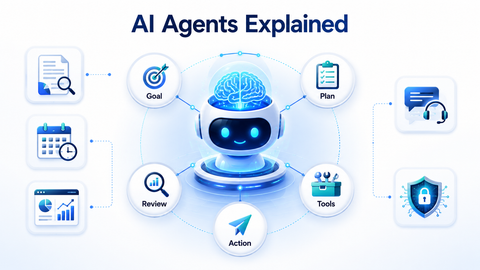
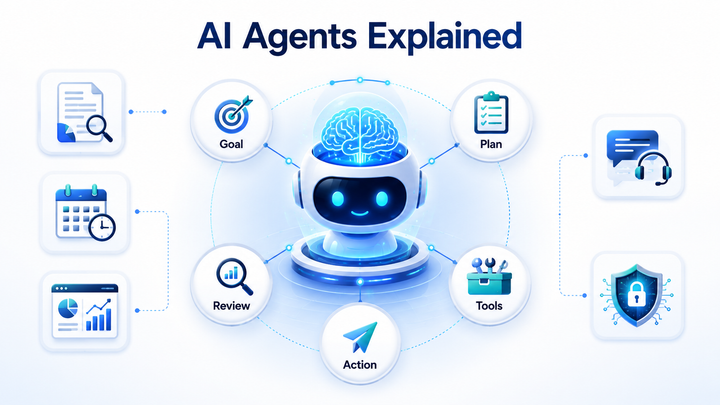
An AI agent usually includes four core parts:
| Part of AI Agent | Simple Explanation |
|---|---|
| Goal | The task or outcome the agent is trying to complete |
| Reasoning | The process used to decide what step should come next |
| Tools | Connected apps, databases, files, or systems the agent can use |
| Feedback | Information used to check whether the task is moving correctly |
For example, a basic AI assistant may answer, “What is workflow automation?” An AI agent may go further by reading a process document, identifying repeated tasks, preparing a checklist, and suggesting an improved workflow structure.
Why AI Agents Matter Today
AI agents matter because they are changing how people interact with software, data, and digital systems. Instead of opening multiple apps and manually moving information from one place to another, users can describe a goal in plain language. The agent can then assist with research, planning, classification, summarization, monitoring, reporting, and workflow coordination.
This affects many groups. Students can use AI agents to understand complex topics and organize study notes. Professionals can use them for document review, project planning, data analysis, and content research. Small organizations can use them to reduce repetitive administrative tasks. Larger enterprises can connect AI agents with customer support, cybersecurity monitoring, compliance review, software development, and business intelligence systems.
AI agents also help solve common digital problems. These include information overload, slow manual research, repeated data entry, fragmented workflows, delayed reporting, and inconsistent documentation. In a structured environment, an AI agent can reduce the time needed to move from question to useful output.
However, AI agents are not perfect. They can misunderstand instructions, produce inaccurate outputs, rely on incomplete data, or take steps that need human review. This is why human oversight, clear permissions, data privacy controls, and testing are important. The safest use of AI agents is not blind automation, but guided automation with verification.
A simple way to understand their value is this:
| Problem | How AI Agents May Help |
|---|---|
| Too much information | Summarize and organize key points |
| Repeated workflow steps | Assist with structured automation |
| Complex research | Break questions into smaller tasks |
| Slow reporting | Prepare draft reports from data |
| Policy confusion | Highlight rules, risks, and review areas |
| Software complexity | Connect tools through natural language |
AI agents are becoming important in areas such as AI automation, cloud computing, data privacy, compliance management, cybersecurity, machine learning operations, and enterprise software. These are high-intent technology areas because they connect directly with productivity, risk management, and digital transformation.
Recent Updates and Trends
The past year has seen fast movement around agentic AI. Enterprise interest increased as organizations began testing agents for workflow automation, knowledge management, customer support, software development, and internal operations. A NASSCOM 2025 report noted that many enterprises were preparing specific budgets to test and build AI agents in 2025, showing that agentic AI has moved from theory into active experimentation.
Another important trend is the difference between experiments and mature adoption. Capgemini research found that only a small share of organizations had deployed AI agents at scale, while many were still in pilot or partial-scale stages. This means AI agents are growing quickly, but many organizations are still learning how to manage reliability, governance, and integration.
In July 2024, the U.S. National Institute of Standards and Technology released a Generative AI Profile under its AI Risk Management Framework. This profile focuses on identifying risks from generative AI and gives organizations a structure for managing those risks. This matters for AI agents because many agents use generative AI models to reason, write, summarize, and make recommendations.
In Europe, the AI Act became a major regulatory development. The final text was published in the Official Journal of the European Union on 12 July 2024, and analysis of the Act notes that it came into force on 1 August 2024. The law uses a risk-based approach, meaning AI systems with higher potential harm face stronger obligations.
In India, AI development also gained policy attention. The IndiaAI Mission was approved in March 2024 with a government budget outlay of ₹10,371.92 crore over five years, according to official government information. The mission focuses on AI infrastructure, datasets, applications, and the broader goal of making AI work for India.
These updates show one clear pattern: AI agents are not only a technology trend. They are also becoming part of governance, infrastructure, digital policy, and organizational risk planning.
Laws, Policies, and Governance
AI agents are affected by laws and policies because they can process data, generate content, make recommendations, and interact with digital systems. This creates questions around privacy, transparency, accountability, cybersecurity, intellectual property, and fairness.
In India, AI agents may be affected by data protection principles, digital governance expectations, and sector-specific rules. Organizations using AI agents should consider whether personal data is being processed, whether user consent is needed, whether sensitive information is protected, and whether automated outputs require human review. India’s broader AI policy direction is linked with the IndiaAI Mission, which supports AI infrastructure and responsible adoption.
In the European Union, the AI Act is especially relevant for AI governance. It classifies AI systems based on risk and places obligations on certain developers and deployers. High-risk systems may require documentation, risk management, data governance, transparency, and human oversight. AI agents used in sensitive areas may need stronger review than agents used for simple productivity tasks.
In the United States, NIST’s AI Risk Management Framework is voluntary, but it is widely used as a practical reference for AI governance. Its Generative AI Profile helps organizations think about risks such as inaccurate outputs, harmful content, privacy exposure, and misuse. This framework is useful for AI agents because agents often combine generative AI with external tools.
Good AI agent governance should include:
- Clear user permissions
- Data privacy checks
- Human review for sensitive outputs
- Logging of important actions
- Testing before deployment
- Defined limits on what the agent can access
- Cybersecurity controls
- Regular evaluation for accuracy and bias
A safe AI agent should not have unlimited access to private systems. Access should be limited to what is necessary for the task. For example, an agent that summarizes documents does not need permission to change financial records. An agent that creates reports should not automatically send them to external parties without review.
Tools and Resources
AI agents can be understood better through practical tools, templates, and learning resources. These resources help users explore agentic AI without depending only on technical theory.
| Resource Type | Helpful Use |
|---|---|
| AI workflow templates | Map tasks, inputs, outputs, and review steps |
| Prompt planning sheets | Define goals, instructions, limits, and expected format |
| Risk assessment checklist | Review privacy, accuracy, security, and compliance concerns |
| AI governance framework | Create internal rules for responsible use |
| Data classification guide | Decide what information an agent can access |
| Human review checklist | Confirm outputs before important use |
| Automation flow diagrams | Show how agent actions move across tools |
| Knowledge base documents | Give agents reliable internal information |
Useful AI agent learning areas include:
- Artificial intelligence basics
- Machine learning concepts
- Natural language processing
- Generative AI explanation
- Workflow automation
- Cloud computing basics
- Cybersecurity awareness
- Data privacy and compliance
- Business intelligence and analytics
- AI governance and responsible AI
A simple AI agent planning template may include:
| Planning Question | Example Answer |
|---|---|
| What is the goal? | Summarize monthly support themes |
| What data is needed? | Approved support notes and FAQ documents |
| What tools are allowed? | Document reader and report editor |
| What should be restricted? | Personal data and account credentials |
| Who reviews the output? | Team lead or assigned reviewer |
| What is the final result? | A structured summary with key topics |
This type of planning helps prevent unclear automation. It also makes AI agent use easier to explain, audit, and improve.
Simple Visual Flow of an AI Agent
| Step | Process |
|---|---|
| User gives a goal | “Create a summary of this document” |
| Agent understands task | Identifies topic, format, and expected output |
| Agent plans steps | Reads, extracts, organizes, and checks |
| Agent uses tools | Accesses approved document or database |
| Agent creates output | Produces summary, table, or recommendation |
| Human reviews result | Checks accuracy and final use |
This flow shows why AI agents are different from basic chat tools. The important part is not only answering, but also planning and acting within controlled limits.
FAQs
What is an AI agent in simple words?
An AI agent is a digital system that can understand a goal, make decisions, use available tools, and complete steps toward a result. It is more advanced than a basic chatbot because it can often plan and act across multiple steps.
How are AI agents different from chatbots?
A chatbot mainly responds to user messages. An AI agent can often reason through a task, decide what action to take, use tools, and check whether the result matches the goal. Some chatbots may include agent-like features, but not all chatbots are full AI agents.
Are AI agents always accurate?
No. AI agents can make mistakes, misunderstand context, or generate incomplete information. Outputs should be checked, especially when the task involves legal, financial, medical, technical, or personal data.
Where are AI agents used?
AI agents are used in workflow automation, document analysis, research support, customer support, cybersecurity monitoring, software development assistance, data reporting, and knowledge management. Their use depends on data access, system permissions, and human review.
What are the main risks of AI agents?
Common risks include inaccurate outputs, privacy exposure, over-automation, weak access controls, bias, poor documentation, and unclear accountability. These risks can be reduced through testing, limited permissions, review workflows, and AI governance rules.
Conclusion
AI agents are an important development in artificial intelligence because they move beyond simple answers and into goal-based digital assistance. They can help with research, planning, workflow automation, reporting, knowledge management, cybersecurity support, and business intelligence tasks.
Their value comes from combining reasoning, tool use, data access, and structured outputs. At the same time, they require careful control. AI agents should be designed with clear goals, limited permissions, privacy safeguards, human review, and compliance awareness.
The recent growth of agentic AI, along with policy updates such as the EU AI Act, NIST’s Generative AI Profile, and India’s AI Mission, shows that AI agents are becoming part of both technology strategy and responsible governance. The most useful approach is to treat AI agents as powerful assistants that support human decisions, not as systems that should operate without oversight.