VPN Services Overview: Key Details and Basic Information
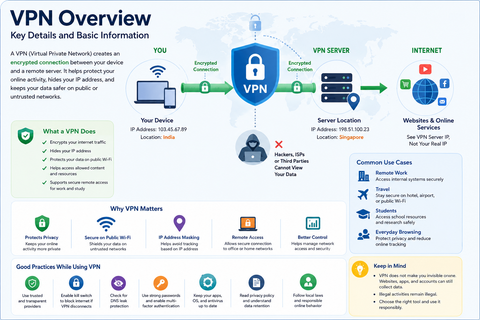
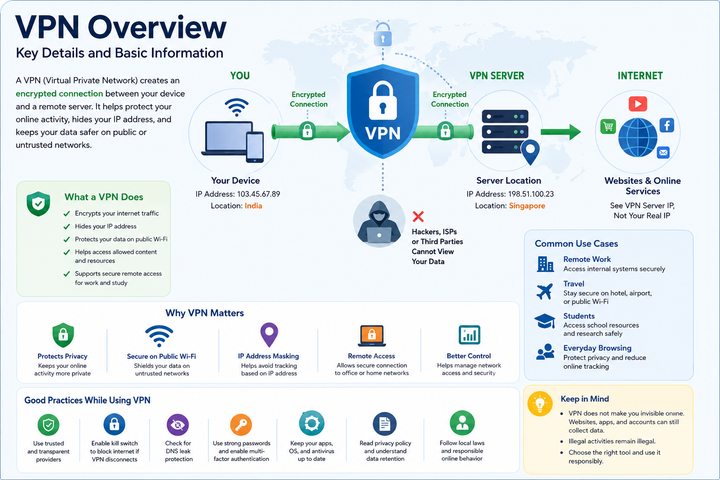
A VPN, or virtual private network, is a digital privacy technology that creates an encrypted connection between a user’s device and a remote network server. This connection can help protect browsing activity from being easily viewed on public Wi-Fi, workplace networks, or unsecured internet connections.
VPN technology exists because the open internet was not designed with privacy as its default setting. When a person browses the web, uses apps, logs in to accounts, or sends data online, that information may pass through multiple networks. Without encryption, some data may be exposed to network operators, unsecured routers, malicious actors, or poorly protected systems.
A VPN helps by creating a secure tunnel. The user’s internet traffic travels through that encrypted tunnel before reaching the wider web. This does not make a person invisible online, but it can reduce exposure to certain privacy and network-security risks.
In simple terms, VPN technology is used for:
- Secure browsing on public Wi-Fi
- Encrypted internet traffic
- Privacy protection from network-level tracking
- Remote access to internal systems
- Protection against some forms of data interception
- Masking of visible IP address information
- Safer access when using shared networks
For general users, a VPN is often linked with online privacy. For organizations, it is also linked with cybersecurity, remote access, compliance controls, and data protection.
Why VPN Technology Exists
VPNs were originally developed to help organizations connect remote users to private business networks. Over time, VPN use expanded to personal privacy, secure browsing, research, travel connectivity, and protection on public internet connections.
A VPN does three core things:
- It encrypts traffic between the device and the VPN server
- It can replace the visible IP address with the VPN server’s IP address
- It can route data through a chosen network location
This helps users reduce direct exposure of browsing activity on local networks. For example, when someone uses airport Wi-Fi, hotel Wi-Fi, café Wi-Fi, or shared apartment internet, the connection may not always be secure. A VPN adds an encrypted layer between the device and the VPN network.
However, a VPN is not a complete cybersecurity solution. It does not automatically stop phishing, weak passwords, malware, fake websites, or unsafe downloads. It should be seen as one part of a broader online safety approach.
| VPN Function | What It Helps With | What It Does Not Fully Solve |
|---|---|---|
| Encryption | Reduces exposure on unsafe networks | Does not stop all cyberattacks |
| IP masking | Reduces direct IP visibility | Does not guarantee anonymity |
| Remote access | Helps connect to internal systems | Needs strong login security |
| Public Wi-Fi protection | Adds a secure tunnel | Does not verify website authenticity |
| Privacy control | Limits some network tracking | Does not erase account-level tracking |
Why VPNs Matter Today
VPNs matter because digital activity has become a routine part of banking, learning, work, communication, entertainment, and identity verification. More people use mobile data, home Wi-Fi, public networks, and cloud-based platforms every day.
The topic affects:
- Individuals using public Wi-Fi
- Remote workers accessing company systems
- Businesses managing secure network access
- Students using shared networks
- Travelers using unfamiliar internet connections
- Journalists, researchers, and analysts handling sensitive information
- Families concerned about privacy and account protection
VPNs can help solve several practical problems.
They can improve safety on shared networks, where attackers may attempt data interception. They can reduce direct exposure of a user’s IP address. They can help organizations create controlled remote access to internal platforms. They can also support secure communication when employees are outside the company network.
For Indian users, VPN awareness has grown because of increasing digital payments, online account activity, cybersecurity incidents, and stronger data privacy conversations. India’s digital economy has expanded rapidly, making privacy, secure browsing, and identity protection more important for both individuals and organizations.
Recent Updates and Trends
VPN technology has changed in the past year because of AI-driven cyber risks, stronger privacy laws, and higher demand for stable encrypted connections.
One recent trend is the move toward broader digital security platforms. In 2025, VPN providers expanded beyond basic encrypted browsing into identity protection, phishing alerts, data-leak monitoring, and stronger connection reliability. This reflects a larger cybersecurity shift, where users want privacy, device safety, and account protection together.
Another technical trend is the adoption of stronger encryption approaches. VPN discussions in 2025 and 2026 increasingly mention post-quantum encryption, faster tunnel protocols, mobile reliability, and better protection against unstable network switching. These updates matter because people often move between Wi-Fi and mobile networks throughout the day.
A May 2026 research paper on VPN-based web measurement found that different VPN providers may produce different web-routing and infrastructure results from the same country. This means VPN networks are not identical, and their DNS handling, routing paths, and infrastructure choices can affect what users experience online.
In India, VPN-related regulation remains closely connected with cybersecurity and data retention. The CERT-In directions issued in 2022 continue to be important because they require certain categories of providers, including VPN providers operating in India, to maintain user information for five years. CERT-In clarified in May 2022 that these rules apply to corporate VPNs as well as individual VPN users.
A major privacy update came through India’s Digital Personal Data Protection Rules, 2025. The Government of India notified these rules on 14 November 2025, creating the practical framework for the Digital Personal Data Protection Act, 2023. These rules are relevant because VPN platforms, cybersecurity platforms, cloud platforms, and many digital systems may handle personal data.
VPN Feature Importance Graph
Text graph: relative importance for general users and organizations
Encryption Strength ██████████
Data Privacy Controls ██████████
Connection Reliability █████████
No-Log Transparency ████████
Device Compatibility ████████
Remote Access Security ███████
DNS Leak Protection ███████
Threat Alerts ██████
Laws, Policies, and Compliance Context in India
VPN use in India is generally legal, but users and organizations must follow Indian law. A VPN cannot be used to hide unlawful activity, bypass lawful restrictions, commit fraud, access prohibited platforms, or violate platform rules.
The main regulatory area linked with VPNs in India is cybersecurity reporting and data retention. CERT-In, India’s national computer emergency response authority, issued directions in 2022 under the Information Technology Act framework. These directions require certain digital infrastructure operators to keep specified records and report cyber incidents within defined timelines.
For VPN providers operating Indian infrastructure, the key issue is retention of user information. CERT-In’s clarification said the rules applied to enterprise and individual VPN use, not only consumer platforms.
The second major area is personal data protection. India’s DPDP Rules, 2025 support the implementation of the Digital Personal Data Protection Act, 2023. These rules focus on transparency, data security, consent, children’s data, breach-related responsibilities, and user rights. The rules were notified on 14 November 2025.
For users, this means privacy claims should be read carefully. A VPN may encrypt traffic, but the provider may still process account data, connection metadata, payment information, support records, or diagnostic logs depending on its policy and legal obligations.
For organizations, VPN use should be combined with:
- Strong password rules
- Multi-factor authentication
- Device management
- Access permissions
- Security logs
- Employee policy training
- Incident response planning
- Data retention controls
- Regular security review
A VPN is useful, but it is not a substitute for full cybersecurity governance.
Helpful Tools and Resources
Several types of tools and resources can help users understand VPN technology more clearly.
VPN protocol information
Common VPN protocols include WireGuard, OpenVPN, and IKEv2/IPsec. Each protocol has different strengths related to speed, stability, compatibility, and security design.
DNS leak test tools
These help check whether DNS requests are going outside the encrypted VPN tunnel. A DNS leak may reveal browsing lookup activity to a network operator.
IP address check tools
These show the visible IP address and approximate network location seen by websites. Users can compare the result before and after connecting through a VPN.
Password manager tools
A VPN does not protect weak passwords. A password manager helps create and store stronger account credentials.
Multi-factor authentication apps
Authentication apps add another login layer. This is important because encrypted browsing alone cannot protect an account if credentials are stolen.
Cybersecurity awareness resources
Government cybersecurity portals, cyber hygiene guides, and data-protection explainers can help users understand phishing, malware, identity theft, and account safety.
Privacy policy checklist
Before using any VPN platform, users can review:
- What data is collected
- How long data is retained
- Whether connection logs are maintained
- Where the company is legally based
- Whether independent audits are available
- Whether DNS leak protection is included
- Whether kill switch controls exist
- Whether multi-device access is supported
- Whether customer data can be requested by authorities
Key VPN Terms Explained
| Term | Simple Meaning |
|---|---|
| Encryption | Converts data into unreadable form during transmission |
| IP address | A network identifier visible to websites and platforms |
| VPN tunnel | Encrypted route between the device and VPN network |
| DNS leak | When website lookup requests go outside the encrypted tunnel |
| Kill switch | Stops internet access if VPN connection drops |
| Protocol | Technical method used to create the encrypted connection |
| Server location | Network location selected for routing traffic |
| Metadata | Data about a connection, such as timing or device details |
Practical Safety Checklist
| User Need | Helpful VPN-Related Feature |
|---|---|
| Public Wi-Fi protection | Strong encryption and kill switch |
| Privacy from local network | DNS leak protection |
| Stable mobile use | Reliable protocol support |
| Remote work access | MFA and controlled network permissions |
| Data privacy review | Clear retention and logging policy |
| Account protection | Password manager and MFA |
FAQs
What is a VPN?
A VPN is a virtual private network that creates an encrypted connection between a user’s device and a remote network server. It helps reduce exposure of internet traffic on unsafe or shared networks.
Does a VPN make someone fully anonymous?
No. A VPN can mask the visible IP address and encrypt network traffic, but it does not remove tracking from logged-in accounts, browser cookies, device fingerprints, payment records, or unsafe online behavior.
Is VPN use legal in India?
VPN use is generally legal in India. However, users must follow Indian law. VPN technology cannot be used for unlawful activity, fraud, illegal platform access, or violation of valid government restrictions.
Why did some VPN providers remove Indian servers?
After CERT-In’s 2022 cybersecurity directions, some providers changed their India infrastructure approach because of data-retention requirements. The rules require certain user-related information to be retained for five years by covered providers operating in India.
Can a VPN protect against phishing?
Not completely. A VPN encrypts network traffic, but phishing depends on deception. Users still need careful link checking, strong passwords, multi-factor authentication, and updated device security.
Conclusion
VPN technology is an important part of online privacy and cybersecurity awareness. It helps create an encrypted connection, reduce exposure on shared networks, and support secure remote access. For individuals, it can improve privacy during browsing and public Wi-Fi use. For organizations, it can support controlled access to internal systems.
In India, VPN use is shaped by cybersecurity rules, data retention requirements, and the newer personal data protection framework. CERT-In’s VPN-related directions and the DPDP Rules, 2025 both show that privacy tools must be understood alongside legal and compliance responsibilities.
A VPN should not be treated as a complete safety solution. It works best when combined with strong passwords, multi-factor authentication, device updates, careful browsing habits, and clear data-protection practices. For general users, the most important point is simple: a VPN can improve network privacy, but responsible digital behavior remains essential.