Middleware for Application Development Explained: Types, Architecture, APIs, Integration & Software Insights
Middleware for application development is software that operates between applications, services, databases, operating systems, devices, and other technology components to enable communication and coordination.
It is often described as a software layer or “software glue” because it helps systems that were not originally designed to communicate directly exchange data and functionality. Modern middleware can support APIs, message queues, application integration, authentication, data transformation, transaction processing, service communication, and cloud-based integration.
Middleware has become particularly important as applications have moved from standalone systems toward microservices, cloud-native applications, hybrid environments, APIs, event-driven architectures, and distributed systems.
What Is Middleware in Application Development?
Middleware is a software layer positioned between different application components or between an application and underlying resources.
A simplified model looks like this:
Application → Middleware → Services / Databases / APIs / External Systems
Instead of requiring every application to understand every external system directly, middleware can provide common communication and integration functions.
For example, an e-commerce application may use middleware to coordinate information between:
- Web or mobile application
- Product database
- Inventory system
- Payment system
- Order management system
- Shipping platform
- Customer relationship system
This reduces the need for every component to maintain a separate direct connection.
Why Middleware Is Important
Modern applications commonly depend on multiple systems operating across different environments.
These systems may use different:
- Programming languages
- Data formats
- Operating systems
- Communication protocols
- Databases
- Cloud environments
- Security mechanisms
Middleware helps bridge these differences.
IBM describes middleware as a connectivity layer that helps applications and distributed components communicate, while enterprise application integration commonly uses APIs and middleware to connect disparate systems.
Key advantages include:
- Application interoperability
- Centralized integration logic
- Reusable communication components
- Data transformation
- Message routing
- API management
- Authentication
- Transaction coordination
- Monitoring
- Support for distributed architectures
How Middleware Works
A typical middleware workflow can be represented as:
Application Request → Middleware → Validation → Transformation → Routing → Target System → Response
Consider an application requesting customer information from a legacy database.
The application does not necessarily need to understand the database's internal structure.
Middleware can:
- Receive the request.
- Authenticate the application.
- Validate the request.
- Transform the request into the required format.
- Connect to the target database.
- Retrieve the information.
- Transform the response.
- Return the result to the application.
- Record relevant monitoring information.
This abstraction allows developers to work with a consistent interface while the middleware manages underlying integration details.
Main Types of Middleware
Middleware can be categorized according to the type of communication or application problem it addresses.
1. Message-Oriented Middleware
Message-oriented middleware (MOM) enables applications to communicate through messages.
A message can be placed into a queue or handled by a broker before being delivered to another application.
This supports asynchronous communication.
For example:
Application A → Message Queue → Application B
If Application B is temporarily unavailable, the message can remain in the queue until the receiving system becomes available, depending on the queue's configuration.
Common capabilities include:
- Message queues
- Message routing
- Delivery management
- Retry mechanisms
- Asynchronous processing
- Event handling
2. API Middleware
API middleware provides mechanisms for creating, exposing, securing, managing, and monitoring APIs.
It may include:
- API gateways
- Authentication
- Authorization
- Rate limiting
- Request validation
- API versioning
- Traffic management
- Monitoring
- Developer portals
API integration allows applications to exchange data and functionality through defined interfaces.
3. Database Middleware
Database middleware simplifies communication between applications and database systems.
It can help applications interact with different databases without requiring every application component to manage database connectivity independently.
Functions can include:
- Database connections
- Query management
- Data access
- Connection pooling
- Data transformation
- Transaction coordination
4. Remote Procedure Call Middleware
Remote procedure call (RPC) middleware allows an application to invoke a procedure or function located on another system.
From the developer's perspective, the remote operation can appear similar to calling a local function, while the middleware manages communication between the systems.
5. Transaction Middleware
Transaction middleware helps coordinate operations that involve multiple systems or resources.
This can be important when a workflow includes several dependent steps.
For example:
Order Creation → Inventory Update → Payment Processing → Confirmation
Transaction-management mechanisms can help maintain consistency when one part of the workflow fails.
6. Enterprise Application Integration Middleware
Enterprise application integration middleware connects multiple business applications and data sources.
It can integrate systems such as:
- ERP
- CRM
- Databases
- Supply-chain applications
- HR systems
- Analytics platforms
- Legacy applications
Enterprise integration architectures can use centralized hubs, APIs, message brokers, and other integration mechanisms.
7. Enterprise Service Bus
An Enterprise Service Bus (ESB) is a middleware architecture that can provide centralized routing, transformation, orchestration, and communication between enterprise applications.
ESBs traditionally played an important role in service-oriented architectures.
Modern cloud-native architectures increasingly use combinations of APIs, event brokers, microservices, service meshes, and iPaaS instead of relying entirely on a centralized ESB.
8. Integration Platform as a Service
iPaaS provides cloud-based tools for integrating applications, services, data, and workflows.
It can include:
- Prebuilt connectors
- Integration workflows
- API management
- Data transformation
- Monitoring
- Automation
- Hybrid integration
IBM describes iPaaS as an approach for connecting applications, data, processes, and services across hybrid environments.
Middleware Architecture
A typical middleware architecture can contain several layers.
Application Layer
This includes applications such as:
- Mobile applications
- Web applications
- Enterprise applications
- Microservices
API Layer
The API layer exposes controlled interfaces between applications and services.
Middleware Layer
This layer may contain:
- API gateways
- Message brokers
- Integration engines
- Service buses
- Transformation components
- Authentication systems
- Workflow engines
Data Layer
The data layer can include:
- Relational databases
- NoSQL databases
- Data warehouses
- Files
- External data sources
Infrastructure Layer
This includes:
- Servers
- Containers
- Cloud infrastructure
- Networking
- Operating systems
- Storage
Core Middleware Components
API Gateway
An API gateway provides a controlled entry point for API traffic.
It can handle:
- Authentication
- Authorization
- Routing
- Rate limiting
- Request transformation
- Monitoring
- Traffic policies
Message Broker
A message broker receives, routes, and distributes messages between applications.
It can support asynchronous communication and help decouple application components.
Integration Engine
An integration engine can coordinate workflows between different applications.
It may transform data, route messages, invoke APIs, and manage integration rules.
Data Transformer
Different systems may represent the same information differently.
For example:
System A: JSON
System B: XML
System C: CSV
A middleware transformation layer can convert data between supported formats.
Authentication Layer
Middleware can enforce authentication and authorization before requests reach protected services.
Monitoring Layer
Monitoring components can track:
- Requests
- Messages
- Errors
- Latency
- Throughput
- Integration status
- System availability
Middleware and APIs
APIs and middleware are closely related but are not identical.
An API defines how software components communicate.
Middleware can provide the infrastructure and logic required to manage that communication.
For example:
Mobile App → API Gateway → Middleware → Customer Database
The API defines the interface, while middleware can handle authentication, routing, transformation, monitoring, and integration.
API-based integration is widely used to connect enterprise applications, databases, workflows, and external systems.
Middleware Integration Patterns
Point-to-Point Integration
Two systems communicate directly.
System A ↔ System B
This approach can be straightforward for small environments, but many direct connections can become difficult to manage as the number of applications increases. IBM describes this scaling problem as “spaghetti integration.”
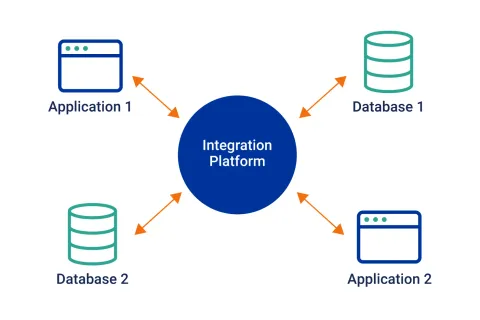
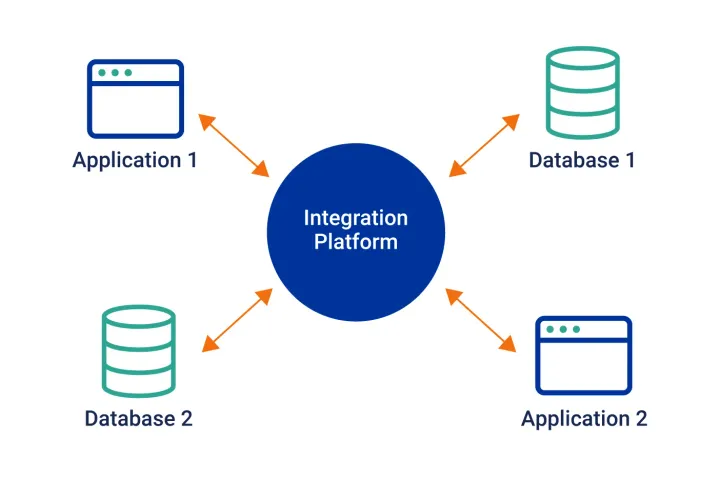
Hub-and-Spoke Integration
Multiple systems connect through a central integration hub.
System A → Hub ← System B
System C → Hub ← System D
The hub can manage routing, transformation, authentication, and monitoring.
Service-Oriented Architecture
SOA organizes software around reusable services with defined interfaces and communication standards.
This encourages interoperability and reuse.
Microservices Architecture
Microservices divide applications into smaller, independently deployable services.
Communication commonly occurs through APIs, messaging systems, or event-driven mechanisms.
Modern integration architectures often combine microservices with API gateways, message brokers, and service meshes.
Event-Driven Architecture
In an event-driven architecture, systems communicate through events.
For example:
Order Created → Event → Inventory System → Event → Shipping System
This approach can support loosely coupled and asynchronous workflows.
Middleware in Cloud-Native Application Development
Cloud-native applications often operate across:
- Public cloud
- Private cloud
- Hybrid environments
- Containers
- Kubernetes environments
- Serverless systems
- Microservices
Middleware can provide communication and integration capabilities across these distributed environments.
Modern middleware also supports containerized applications and can contribute to continuous integration and continuous delivery workflows.
Middleware and Microservices
Microservices increase application flexibility but also introduce communication complexity.
A system with dozens of services may require:
- API communication
- Event messaging
- Service discovery
- Authentication
- Observability
- Traffic management
- Fault handling
Middleware components can provide common infrastructure for these requirements.
For example:
Frontend → API Gateway → Service A
** ↘ Service B**
** ↘ Service C**
Message brokers can separately support asynchronous communication.
Middleware and Data Transformation
One of middleware's important functions is transforming information between incompatible systems.
For example:
Application
     ↓
JSON Request
     ↓
Middleware
     ↓
XML Transformation
     ↓
Legacy System
The receiving system does not necessarily need to be redesigned to understand the application's original data format.
Transformation can involve:
- Field mapping
- Format conversion
- Data normalization
- Schema transformation
- Encoding conversion
- Validation
Middleware Security
Security should be integrated throughout middleware architecture.
Authentication
Middleware can verify the identity of users, applications, devices, or services.
Authorization
Authorization determines which authenticated entity can access a particular resource.
Encryption
TLS and other encryption mechanisms can protect data while it moves between systems.
API Security
API middleware can enforce:
- Access tokens
- Request validation
- Rate limits
- API keys
- Signature validation
- IP restrictions where appropriate
Secrets Management
Sensitive credentials such as API keys and database passwords should be stored using appropriate secrets-management mechanisms rather than embedded directly into application code.
Monitoring
Security monitoring can identify unusual requests, repeated authentication failures, unexpected traffic, and other anomalies.
Middleware Performance and Scalability
Middleware can become a critical part of an application's performance profile.
Important metrics include:
- Request latency
- Message throughput
- Queue depth
- Error rate
- CPU usage
- Memory utilization
- Connection utilization
- API response time
Scalability techniques can include:
- Horizontal scaling
- Load balancing
- Message partitioning
- Connection pooling
- Caching
- Asynchronous processing
- Container orchestration
However, adding middleware does not automatically improve performance. Poorly designed middleware can introduce additional latency or create a central bottleneck.
Middleware Reliability
Distributed applications need mechanisms for handling failures.
Useful patterns include:
- Retry policies
- Timeouts
- Circuit breakers
- Dead-letter queues
- Idempotency
- Health checks
- Failover
- Redundant infrastructure
- Transaction reconciliation
For example, a message that repeatedly fails processing can be moved into a dead-letter queue for later investigation rather than blocking the entire message stream.
Middleware Observability
Observability is important because middleware often sits between several systems.
A good observability architecture can provide:
Logs
Detailed records of application and integration events.
Metrics
Quantitative measurements such as latency and throughput.
Traces
End-to-end visibility into requests that travel through multiple services.
Alerts
Automated notifications when defined thresholds or unusual patterns occur.
Without sufficient observability, identifying whether a problem originates in an application, API, database, network, or middleware layer can become difficult.
Middleware for Legacy Application Modernization
Many organizations still operate legacy applications that contain important business data and processes.
Replacing these systems completely may not always be practical.
Middleware can provide a bridge between legacy systems and newer applications.
For example:
Modern Web App → API → Middleware → Legacy Database
This approach can allow organizations to introduce modern interfaces while keeping existing backend systems in operation.
IBM identifies application integration and middleware as mechanisms that can help organizations connect modern systems with legacy environments.
Middleware Use Cases
Banking and Fintech
Middleware can connect:
- Banking applications
- Payment systems
- Customer databases
- Fraud systems
- Transaction engines
- Mobile applications
Healthcare
Healthcare environments can use middleware to connect:
- Electronic health records
- Laboratory systems
- Medical devices
- Imaging systems
- Telehealth platforms
Interoperability is particularly important where multiple healthcare applications need to exchange information securely.
E-Commerce
Middleware can connect:
- Product catalogs
- Inventory
- Order processing
- Payment systems
- Customer databases
- Logistics platforms
Manufacturing
Industrial environments can integrate:
- ERP
- Manufacturing execution systems
- Industrial applications
- Sensors
- Analytics
- Supply-chain platforms
Enterprise Software
Middleware can connect CRM, ERP, HR, finance, analytics, and other enterprise systems.
IBM notes that enterprise integration can help connect applications, data, services, and business processes across diverse IT environments.
Middleware vs API vs API Gateway vs iPaaS
| Technology | Primary Role |
|---|---|
| Middleware | Broad communication and integration layer |
| API | Defined interface for software communication |
| API Gateway | Controlled entry point for API traffic |
| Message Broker | Routes and manages messages |
| ESB | Centralized enterprise integration architecture |
| iPaaS | Cloud-based integration platform |
| Service Mesh | Manages service-to-service communication |
| PaaS | Platform for building and running applications |
These technologies can overlap, but they address different architectural responsibilities.
Advantages of Middleware
Application Interoperability
Middleware helps applications built with different technologies communicate.
Reusability
Common integration logic can be reused across multiple applications.
Loose Coupling
Systems can communicate without exposing all of their internal implementation details.
Faster Integration
Prebuilt connectors and integration components can reduce repetitive development work.
Centralized Management
Integration policies, monitoring, and routing can be managed from common infrastructure.
Legacy Integration
Middleware can provide communication between older systems and newer applications.
Scalability
Messaging, routing, and distributed processing can support larger application environments when properly designed.
Challenges of Middleware
Middleware also introduces additional architectural considerations.
Complexity
Each additional integration component creates another layer that developers need to understand and monitor.
Dependency Management
Changes to APIs, schemas, protocols, or middleware components can affect connected applications.
Performance Overhead
Additional processing can introduce latency.
Security Exposure
A middleware layer can become an important security boundary and therefore requires careful protection.
Operational Requirements
Teams need appropriate monitoring, testing, configuration management, and troubleshooting processes.
Integration Sprawl
Large organizations can accumulate many disconnected middleware tools and integration workflows. A platform-oriented strategy can help standardize integration management.
Low-Code Middleware and Integration
Modern integration platforms increasingly provide visual development environments and prebuilt connectors.
Low-code integration can allow teams to connect applications and data sources through configuration and visual workflows rather than writing every integration from scratch.
Common capabilities include:
- Drag-and-drop workflows
- Prebuilt connectors
- API configuration
- Data mapping
- Workflow automation
- Monitoring dashboards
- Reusable templates
Low-code approaches can accelerate integration, but complex or highly specialized workflows may still require traditional software development.
Middleware and AI
AI is creating new requirements for application integration.
Modern enterprise environments may need middleware to connect AI applications and agents with:
- Enterprise databases
- APIs
- Business applications
- Documents
- Workflow systems
- Identity platforms
- Existing applications
IBM's current middleware materials describe integration platforms as an important layer for connecting AI agents with existing business processes and systems.
This makes governance, authentication, authorization, data access, and observability particularly important when AI systems interact with enterprise resources.
Tools and Technologies Related to Middleware
A middleware ecosystem can include:
- API gateways
- Message brokers
- Enterprise service buses
- iPaaS platforms
- Integration engines
- Service meshes
- Workflow engines
- Event-streaming platforms
- Authentication systems
- Database connectors
- Cloud integration tools
- Monitoring platforms
- Distributed tracing systems
- Container orchestration platforms
The appropriate combination depends on the application's architecture and integration requirements.
Best Practices for Middleware Architecture
Keep Interfaces Well Defined
Use clear API contracts, schemas, and versioning practices.
Prefer Loose Coupling
Avoid unnecessary dependencies between applications.
Design for Failure
Assume that networks, external systems, and individual services can become unavailable.
Use Idempotent Operations
Where appropriate, repeated requests should not create unintended duplicate operations.
Monitor End-to-End Workflows
Monitor both middleware itself and the applications connected to it.
Protect Every Integration Point
Apply authentication, authorization, encryption, and appropriate validation.
Avoid Unnecessary Centralization
A centralized integration layer can simplify governance but may become a bottleneck or single point of failure if poorly designed.
Standardize Integration Patterns
Reusable patterns can reduce architectural inconsistency and simplify maintenance.
Recent Middleware Technology Trends
Several trends are shaping modern middleware architecture:
- API-first application development
- Event-driven architecture
- Cloud-native integration
- Hybrid and multicloud integration
- iPaaS adoption
- Microservices
- Service meshes
- Low-code integration
- Real-time data movement
- AI-assisted integration
- AI-agent connectivity
- Increased observability
- Zero-trust security approaches
The broader shift is from isolated middleware products toward integrated platforms that manage APIs, events, applications, data, and workflows across distributed environments.
FAQs
What is middleware in application development?
Middleware is software that enables communication and coordination between applications, services, databases, devices, and other technology components.
Why is middleware used?
Middleware can simplify application integration, provide communication mechanisms, transform data, manage APIs, route messages, improve interoperability, and connect modern applications with legacy systems.
Is an API middleware?
An API is not necessarily middleware. An API defines an interface for software communication, while middleware is a broader category of software that can manage communication, integration, routing, security, transformation, and other functions.
What is the difference between middleware and an API gateway?
An API gateway is one type of middleware component focused primarily on managing API traffic. Middleware is a broader concept that can include API gateways, message brokers, integration engines, ESBs, database middleware, and other technologies.
Is middleware used in microservices?
Yes. Microservice architectures commonly use API gateways, message brokers, service meshes, event platforms, and other middleware components to manage communication between distributed services.
Conclusion
Middleware for application development provides an important layer between applications, services, databases, APIs, and infrastructure.
Its role has expanded from traditional application connectivity to modern API management, event-driven systems, microservices, cloud integration, hybrid environments, legacy modernization, and AI-enabled applications.
The most effective middleware architecture depends on the application's requirements. Small systems may need only a few lightweight integration components, while large distributed environments may require API gateways, message brokers, integration platforms, service meshes, observability tools, and centralized governance.
A well-designed middleware layer can simplify communication, improve interoperability, support reusable integration patterns, and help applications evolve without requiring every connected system to be redesigned at the same time.
Disclaimer
This article is provided for general educational and informational purposes only. It does not constitute software architecture, cybersecurity, legal, regulatory, or professional advice and is not intended to promote any particular company, platform, technology, or product. Middleware technologies, APIs, cloud platforms, security practices, and software standards continue to evolve. Always evaluate current technical documentation, security requirements, architecture constraints, and organizational needs before implementing middleware in a production environment.