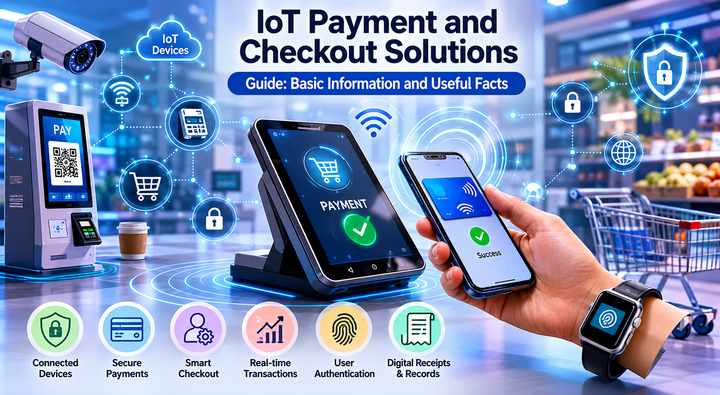
IoT Payment and Checkout Solutions Guide: Basic Information and Useful Facts
IoT payment and checkout solutions refer to digital payment systems that work through connected devices. IoT means Internet of Things. It includes devices that can connect to the internet, exchange data, and respond to instructions. In payments, IoT can connect smart machines, retail counters, vending devices, electric vehicle charging points, wearable devices, connected vehicles, and checkout terminals with digital transaction systems.
The topic exists because digital payments are no longer limited to a smartphone screen or a physical counter. As devices become connected, payment and checkout actions can happen inside the device experience itself. For example, a smart parking system may record entry and exit time, calculate the payable amount, and trigger a user-authorized digital transaction. A connected EV charger may identify charging usage and link it with a payment confirmation. A retail checkout terminal may scan items, apply the right total, and complete a digital transaction through a secure payment method.
IoT payment and checkout systems usually include several parts:
- Connected device or sensor
- User identity layer
- Payment authorization method
- Checkout screen or interface
- Payment network connection
- Transaction confirmation system
- Security and encryption layer
- Receipt or record generation
- Data logs for reconciliation
These systems are used in retail, transport, food outlets, vending machines, parking, fuel stations, EV charging, smart buildings, automated kiosks, and connected mobility. Their purpose is not only transaction completion. They also help connect usage data, billing logic, authentication, and checkout records in one controlled flow.
Why IoT Payment and Checkout Solutions Matter Today
IoT payment and checkout solutions matter because people increasingly expect faster, cleaner, and more connected digital experiences. India has seen rapid adoption of digital payments, especially through UPI. NPCI’s UPI statistics show that in March 2026, UPI had 705 banks live, 22,641.11 million transactions, and transaction value of ₹29,52,542.05 crore. This scale shows how deeply digital payments are embedded in daily activity.
These systems affect several groups:
- Consumers using connected devices
- Retail stores and checkout counters
- EV charging operators
- Parking and mobility systems
- Banks and payment networks
- Fintech companies
- Compliance and security teams
- Device manufacturers
- Data protection officers
- Public infrastructure planners
The main problem these systems solve is friction in the payment flow. Traditional checkout requires several separate steps: product selection, amount confirmation, payment method selection, authentication, transaction confirmation, and receipt creation. IoT payment systems can connect these steps with device data, making the flow more structured.
Common problems addressed include:
- Long checkout queues
- Manual billing errors
- Disconnected device and payment records
- Low visibility of machine usage
- Delayed payment confirmation
- Difficult reconciliation
- Weak transaction traceability
- Limited self-checkout options
- Manual dependency in repetitive payment situations
IoT payment systems also matter for safety and transparency. A connected checkout flow can log transaction time, device identity, amount, payment method, and status. These records can support audit review, dispute handling, and operational analysis when designed properly.
How IoT Payment and Checkout Systems Work
An IoT payment or checkout system follows a sequence. The connected device first records an event, such as item selection, charging session, usage duration, entry scan, or product dispensing. The system then prepares the transaction details and asks the user for authorization through a supported payment method.
| Stage | What Happens | Example |
|---|---|---|
| Device detection | The connected device records activity | Item scan, EV charging start, parking entry |
| Amount calculation | System prepares the transaction value | Time-based usage or item total |
| User confirmation | User reviews transaction details | Screen, app, voice, or approved instruction |
| Authentication | Payment is authorized securely | UPI PIN, biometric, token, or approved factor |
| Payment processing | Transaction moves through payment network | Bank or payment system confirmation |
| Device response | Machine updates status | Gate opens, item dispenses, charging continues |
| Record creation | Digital log is created | Receipt, transaction ID, device ID |
The key point is that the connected device and the payment system must communicate safely. Device identity, user consent, data encryption, and transaction validation are important. A checkout action should not happen silently without proper authorization.
Common Use Cases
| Use Case | IoT Role | Payment Role |
|---|---|---|
| Smart vending | Detects item selection | Completes payment before dispensing |
| EV charging | Tracks energy usage and session status | Links charging session with transaction |
| Parking systems | Reads vehicle entry and exit | Calculates usage-based payment |
| Smart retail checkout | Scans items and updates basket | Enables faster checkout confirmation |
| Connected vehicle payments | Links mobility context with payment approval | Supports fuel, charging, or toll-like use cases |
| Wearable payments | Uses device identity and user action | Supports contactless transaction flow |
| Smart kiosks | Provides self-led interface | Completes digital payment and receipt |
These examples show that IoT payments are not one single technology. They are a combination of connected hardware, software, payment rails, authentication, and compliance controls.
Recent Updates and Trends
The most important recent development in India was the announcement of IoT Payments with UPI at Global Fintech Festival 2025. On 8 October 2025, RBI Governor Sanjay Malhotra announced new digital payment initiatives, including IoT Payments with UPI. NPCI’s release described this as extending India’s digital payment system beyond smartphones to connected devices and intelligent software across mobility, retail, and households.
The same NPCI release explained that user-authorized IoT devices could initiate UPI payments based on contextual triggers, routines, voice, or text instructions, operating across devices or cloud environments. This is important because it moves digital payments from app-only actions toward user-approved connected-device actions.
Another major trend is the growth of UPI itself. A PIB release from April 2026 stated that UPI processed approximately 22,000 crore transactions during calendar year 2025, with a daily average of about 60 crore transactions. It described UPI as reflecting deep penetration of digital payments across citizens, merchants, and businesses.
AI-linked payments are also emerging. In October 2025, Reuters reported that NPCI, Razorpay, and OpenAI launched a pilot for e-commerce payments through ChatGPT using UPI, to evaluate secure user-authorized transactions through AI agents. This shows how payment flows are expanding into conversational and automated interfaces.
Key trends include:
- UPI integration with connected devices
- Biometric and device-based authentication
- Self-checkout systems in retail
- Smart parking and EV charging payments
- Voice-assisted transaction initiation
- AI-agent payment pilots
- Token-based transaction security
- Stronger merchant and device verification
- More detailed transaction logs
- Payment experience embedded inside connected devices
Simple Trend View
| Area | Earlier Approach | Current Direction |
|---|---|---|
| Payment start point | Mobile app or counter | Connected device or smart interface |
| Checkout style | Manual counter billing | Self-checkout and automated flow |
| Authentication | PIN and OTP focused | Multi-factor and biometric options |
| Transaction record | Payment-only record | Device, user, and context-linked log |
| Retail process | Staff-led checkout | Scan, confirm, and digital completion |
| Mobility payments | Separate app or counter | Vehicle, charger, and parking integration |
Illustrative graph: IoT payment adoption focus
2021: QR and app-led payments ███
2022: Contactless checkout grows ████
2023: Smart retail experiments █████
2024: Embedded payment use cases expand ██████
2025: IoT Payments with UPI announced ███████
2026: AI and device-led payment pilots gain attention ████████
This graph is illustrative and shows the direction of industry attention, not a measured national index.
Laws, Policies, and Compliance Context in India
IoT payment and checkout systems in India are affected by payment regulation, cybersecurity expectations, data protection law, merchant verification, authentication rules, and device security practices.
The Reserve Bank of India regulates payment systems in India. Payment infrastructure generally operates under the Payment and Settlement Systems Act, 2007 and RBI’s directions for payment system participants. For IoT checkout systems, this means the payment layer must follow applicable RBI and NPCI requirements.
Payment aggregators are especially relevant when a system facilitates transactions between customers and merchants. RBI issued the Reserve Bank of India Regulation of Payment Aggregators Directions, 2025 on 15 September 2025. Legal commentary on these directions noted that the framework brings physical payment aggregation activities within RBI’s regulatory purview and harmonises categories of payment aggregation.
Authentication is another important area. IoT payment systems must not treat connected-device convenience as a replacement for user authorization. Payment actions should use approved authentication methods, transaction limits where applicable, and clear user consent.
Data protection is also important. IoT checkout systems may collect device IDs, transaction details, location signals, user account references, and usage patterns. India’s Digital Personal Data Protection Act, 2023 applies to digital personal data processing and requires lawful processing based on consent or legitimate uses, along with duties for data fiduciaries. For IoT payment systems, privacy by design is important because device data can become sensitive when linked with payment behaviour.
Cybersecurity is central because connected devices can create attack surfaces. Important controls include device authentication, encryption, secure firmware updates, tamper detection, access control, fraud monitoring, and transaction anomaly detection.
Compliance-aware IoT payment design should include:
- Clear user authorization
- Secure device identity
- Encrypted transaction data
- Limited data collection
- Strong access controls
- Transaction audit logs
- Error and reversal handling
- Fraud detection rules
- Merchant verification
- Regular security testing
- Safe firmware update process
- Clear user communication
Security and Compliance Checklist
| Area | What to Check | Why It Matters |
|---|---|---|
| User consent | Clear approval before payment | Prevents unauthorized transactions |
| Device identity | Registered and verified device | Reduces spoofing risk |
| Authentication | Approved payment verification method | Supports transaction safety |
| Encryption | Protected data in transit and storage | Reduces data exposure |
| Logs | Device ID, time, status, transaction record | Supports audit and dispute review |
| Firmware updates | Secure update process | Reduces device vulnerability |
| Data minimization | Collect only needed data | Supports privacy discipline |
| Merchant verification | Proper onboarding and review | Reduces misuse risk |
| Failure handling | Clear failed transaction process | Avoids confusion at checkout |
Tools and Resources
Helpful tools and resources for understanding IoT payment and checkout systems include:
- NPCI UPI product statistics: Useful for tracking UPI adoption and payment volume trends.
- RBI payment system documents: Useful for understanding India’s payment regulation environment.
- Payment Aggregator Directions reference: Useful for compliance teams reviewing transaction facilitation models.
- UPI developer documentation: Useful for understanding transaction flow, user authorization, and payment response handling.
- Device security checklist: Helps evaluate connected hardware risk.
- Data flow diagram template: Shows how user data, device data, and payment data move through the system.
- Risk assessment worksheet: Helps identify fraud, downtime, privacy, and device tampering concerns.
- Transaction log template: Tracks transaction ID, device ID, time, status, amount, and failure reason.
- Privacy notice template: Helps explain data collection and usage in simple language.
- Incident response checklist: Helps teams plan response steps for payment errors, device compromise, or suspicious activity.
- Reconciliation sheet: Helps match device activity with payment status and settlement records.
- Security testing checklist: Covers access control, network exposure, firmware, API calls, and transaction validation.
Simple transaction record template:
| Field | Example Entry |
|---|---|
| Date and time | Timestamp of checkout |
| Device ID | Registered machine or terminal ID |
| Location tag | Store, charger, kiosk, or parking point |
| Transaction status | Successful, pending, failed, reversed |
| Payment method | UPI, card, wallet, or tokenized mode |
| User confirmation | PIN, biometric, app approval, or other approved method |
| Error note | Network issue, timeout, mismatch, or no error |
| Reconciliation status | Matched or needs review |
Frequently Asked Questions
What are IoT payment and checkout solutions?
IoT payment and checkout solutions are payment systems linked with connected devices. They allow smart machines, terminals, kiosks, vehicles, chargers, or retail devices to support digital checkout after proper user authorization.
How are IoT payments different from normal digital payments?
Normal digital payments often start from a phone app or counter device. IoT payments can start from connected device activity, such as a charging session, vending selection, parking event, or self-checkout scan.
Are IoT payments automatic?
They can be automated in workflow, but payment should still be user-authorized according to applicable rules and system design. Clear consent, authentication, and transaction limits are important.
Where can IoT checkout systems be used?
They can be used in smart retail, vending machines, EV charging points, parking systems, connected vehicles, wearable devices, automated kiosks, and smart building systems.
What are the main risks in IoT payment systems?
Main risks include unauthorized transactions, device tampering, weak authentication, data leakage, network failure, duplicate charges, incorrect device mapping, and poor transaction logging.
Why is security important in IoT checkout?
Security is important because connected devices handle both operational data and payment-related data. A weak device or poorly protected network can create transaction, privacy, and fraud risks.
Conclusion
IoT payment and checkout solutions connect digital payments with smart devices and automated checkout flows. They are becoming important because digital payments are expanding beyond phones and counters into vehicles, kiosks, EV chargers, retail systems, and connected environments.
India’s payment ecosystem is especially relevant because UPI operates at very large scale, and recent developments such as IoT Payments with UPI show a shift toward device-led, user-authorized payment experiences. These systems can improve checkout structure, transaction logging, and operational visibility when designed carefully.
The most important principle is control. IoT payment systems should be convenient, but not uncontrolled. They need secure device identity, clear user authorization, strong authentication, data protection, proper logs, and compliance-aware design. For general readers, the key idea is simple: IoT payments combine connected devices with digital transaction systems, making checkout more integrated while increasing the need for security and responsible data handling.