How to Select Industrial Robots for Manufacturing Operations
Industrial robots are becoming an important part of modern manufacturing. Businesses across automotive, electronics, pharmaceuticals, food processing, and metal production use robotic systems to perform repetitive, precise, and physically demanding operations.
An industrial robot can handle tasks such as welding, assembling, painting, material handling, inspection, and packaging. These machines combine mechanical components, sensors, controllers, and software to perform programmed movements in industrial environments.
As factories adopt advanced manufacturing technologies, understanding industrial robot types, applications, capabilities, and selection factors can help businesses make informed automation decisions.
What Is an Industrial Robot?
An industrial robot is a programmable mechanical system designed to perform manufacturing and production tasks automatically or with limited human intervention.
Most industrial robots consist of several important components:
Robot arm: The mechanical structure that moves and positions objects or tools.
Controller: The unit that processes instructions and manages robot movements.
End effector: A tool attached to the robot, such as a gripper, welding torch, or suction device.
Sensors: Components that detect position, force, movement, or surrounding conditions.
Programming software: Tools used to configure robot movements and operational sequences.
Safety systems: Equipment such as protective barriers, scanners, and emergency stops.
Industrial robots can be installed as individual machines or integrated into complete factory automation systems.
Why Industrial Robots Are Important in Modern Manufacturing
Manufacturing operations often involve repetitive activities that require consistent movement, accurate positioning, and controlled production processes.
Industrial automation systems help manufacturers manage these operations through programmed equipment.
Some important benefits include:
Improved Production Consistency
Industrial robots can repeat programmed movements and operating sequences. This helps manufacturers maintain consistent processes during repetitive production activities.
Precision and Repeatability
Robotic systems can perform movements within defined accuracy and repeatability specifications. This is useful for welding, assembly, inspection, and component handling.
Reduced Repetitive Manual Work
Robots can perform certain repetitive or physically demanding tasks, allowing employees to focus on supervision, quality checks, programming, and other responsibilities.
Continuous Production Operations
Depending on equipment design and operating conditions, industrial robots can support extended production schedules. They still require maintenance, inspection, and appropriate operating supervision.
Better Production Coordination
Robots can communicate with conveyors, sensors, machine tools, and other equipment through integrated control systems.
Improved Workplace Safety
Robots can be used for certain hazardous or physically demanding activities. However, robotic equipment introduces its own risks and requires suitable guarding, risk assessment, and safety procedures.
Major Types of Industrial Robots
Different industrial robot designs are suitable for different applications. Businesses should consider movement requirements, payload, reach, speed, accuracy, and working environment when selecting a robotic system.
1. Articulated Robots
Articulated robots have rotary joints that allow movement across multiple axes. Many industrial models use six axes, although other configurations are available.
These robots are commonly used for:
Automotive welding
Painting operations
Component assembly
Machine tending
Material handling
Industrial packaging
Their flexible movement makes articulated robots useful for applications requiring complex positioning.
2. SCARA Robots
SCARA stands for Selective Compliance Assembly Robot Arm.
SCARA robots are commonly used for assembly and handling operations that require fast, controlled horizontal movement and vertical positioning.
Typical applications include:
Electronics assembly
Component insertion
Small-part handling
Packaging operations
Precision positioning
They are often selected for applications involving repetitive pick-and-place movements.
3. Cartesian Robots
Cartesian robots operate along linear axes, usually X, Y, and Z.
Their movement follows a rectangular coordinate system, making them suitable for applications that require controlled positioning within a defined working area.
Common uses include:
Machine loading
Material handling
Dispensing
Pick-and-place operations
Automated assembly
4. Delta Robots
Delta robots use multiple connected arms attached to a fixed base. Their design allows fast movement for lightweight products.
They are frequently used in food processing, pharmaceutical packaging, sorting, and high-speed picking applications.
5. Cylindrical Robots
Cylindrical robots use rotary and linear movements to operate within a cylindrical working area.
They can be used for material handling, machine loading, and certain assembly operations.
6. Collaborative Robots
Collaborative robots, commonly called cobots, are designed for applications where robots and people may work in close proximity under suitable safety conditions.
Their use can include:
Small-part assembly
Machine tending
Packaging
Quality inspection
Material handling
Not every collaborative robot application is automatically safe for direct human interaction. A proper risk assessment and suitable safety configuration are necessary.
Major Applications of Industrial Robots
Industrial robots are used across multiple sectors. Their applications depend on production requirements, product characteristics, and the level of automation needed.
Automotive Manufacturing
The automotive industry uses industrial robots for welding, painting, component assembly, material handling, and inspection.
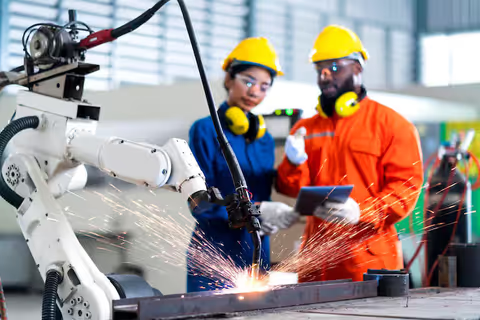
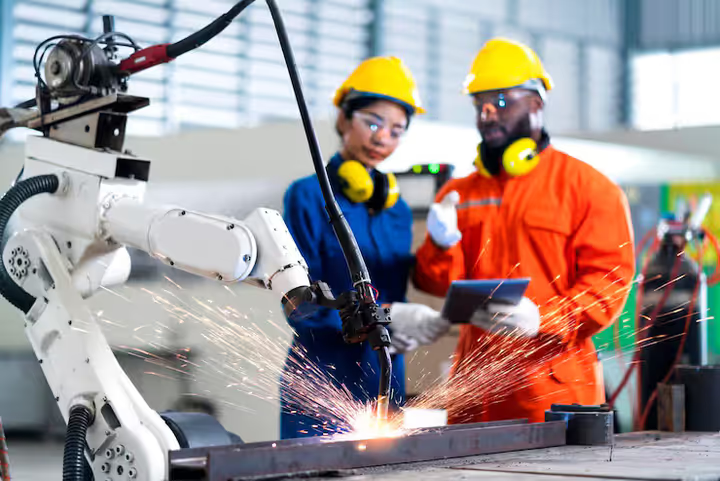
Robotic welding systems can perform programmed welding operations on vehicle structures and components. Robots can also support the movement of parts between manufacturing stations.
Electronics Manufacturing
Electronics manufacturers use robotic systems for component placement, precision assembly, inspection, dispensing, and material handling.
SCARA robots and collaborative robots are useful in selected applications where controlled movement and repeatability are important.
Food and Beverage Production
Food manufacturers use industrial robots for sorting, picking, packing, case handling, and palletizing.
Robotic equipment used in food environments must be appropriate for the required hygiene conditions, cleaning procedures, and product-contact requirements.
Pharmaceutical Manufacturing
Pharmaceutical production may use robots for packaging, handling, inspection, laboratory automation, and selected manufacturing processes.
Equipment selection must consider product protection, contamination control, traceability, validation, and applicable pharmaceutical requirements.
Metal and Machinery Manufacturing
Metalworking facilities use industrial robots for welding, cutting, polishing, machine tending, and component handling.
Robots can also be integrated with CNC machines to automate the loading and unloading of components.
Chemical and Plastics Industries
Robotic systems can handle moulded components, containers, industrial materials, and packaging operations.
They may also be used in selected environments where manual handling involves heat, chemicals, or other workplace hazards.
Industrial Robotic Arm and Its Main Components
An industrial robotic arm is one of the most recognizable forms of industrial robot equipment.
It is a mechanical structure that moves a tool or object through a programmed path.
Its main components include:
Base: Supports the robot and connects it to the installation surface.
Joints: Allow rotational or linear movement.
Links: Connect the joints and form the robot structure.
Wrist: Positions and orients the end effector.
End effector: Performs the required operation.
Servo motors: Drive controlled robot movement.
Controller: Coordinates movement and operating instructions.
Industrial robotic arms are available in different sizes and payload capacities. The appropriate model depends on the weight of the object, required reach, operating speed, and application.
Technologies Used in Industrial Robotics
Modern robotic automation combines mechanical engineering with electronics, software, and industrial communication technologies.
Artificial Intelligence
Artificial intelligence can help robotic systems process information from cameras and sensors, recognize objects, and support selected decision-making tasks.
AI-enabled robotics is used in areas such as visual inspection, object recognition, and adaptive manufacturing processes.
Machine Vision Systems
Machine vision uses cameras and image-processing software to analyze objects and production conditions.
It can support:
Product identification
Component positioning
Defect inspection
Barcode reading
Assembly verification
Sensors and Motion Control
Sensors provide information about position, force, distance, and surrounding conditions.
Motion controllers and servo systems use this information to manage robot movements and improve process control.
Industrial Internet of Things
Industrial Internet of Things technology connects robots with factory systems and monitoring platforms.
It can help production teams review machine status, operating data, downtime, and maintenance information.
Digital Twin Technology
A digital twin is a virtual representation of a physical machine or production process.
Manufacturers can use digital models to study equipment behavior, simulate production layouts, and evaluate certain changes before applying them to physical systems.
How to Select the Right Industrial Robot
Choosing an industrial robot requires more than comparing robot models. Businesses should understand the production task and evaluate the complete automation setup.
Important selection factors include:
Application requirements: Identify whether the robot will perform welding, assembly, painting, inspection, or material handling.
Payload capacity: Check the maximum weight the robot must handle, including tools and other attachments.
Reach and working area: Confirm that the robot can access all required operating positions.
Movement and speed: Review the required cycle time, movement range, and repeatability specifications.
End effector: Select a suitable gripper, suction tool, welding torch, or other application-specific equipment.
Factory layout: Consider available floor space, machine placement, conveyors, and access for maintenance.
Control compatibility: Check integration with PLCs, sensors, CNC machines, and existing production software.
Safety requirements: Evaluate guarding, emergency stops, safety scanners, interlocks, and applicable standards.
Maintenance and support: Review spare-part availability, technical documentation, service coverage, and operator training.
Future production needs: Consider whether the system can support changes in product size, manufacturing processes, or production volume.
A complete assessment should include the robot, tooling, integration, installation, programming, safety equipment, and ongoing maintenance requirements.
Industrial Robot Manufacturers and Automation Suppliers
Industrial robot manufacturers develop robotic arms, controllers, software, and automation technologies for different manufacturing applications.
Some internationally recognized companies in industrial robotics include:
ABB
FANUC
Yaskawa
KUKA
Kawasaki Robotics
Mitsubishi Electric
Their product portfolios vary by robot type, payload, application, and automation requirements.
When comparing industrial robot manufacturers in India, businesses should evaluate local technical support, integration capabilities, equipment specifications, documentation, spare parts, and relevant industry experience.
A robot manufacturer and a system integrator are not necessarily the same. Manufacturers develop the equipment, while system integrators design and connect the robot with other production machinery and factory systems.
Industrial Robotics Trends and Developments
Industrial robotics continues to evolve as manufacturers adopt more flexible and connected production technologies.
Several important developments are influencing the sector:
Growth in Factory Automation
Manufacturers are increasingly evaluating robotic systems for repetitive production tasks, material handling, assembly, and inspection.
The International Federation of Robotics reported that India installed 9,120 industrial robots in 2024, representing a 7% increase over 2023. India ranked sixth globally for new industrial robot installations in that reporting year.
Collaborative Robotics
Collaborative robots are attracting attention because they can support selected tasks in production environments where people and machines work in proximity.
AI-Enabled Inspection
AI and machine vision technologies are being applied to object recognition, defect detection, and inspection processes.
Electronics and Semiconductor Manufacturing
Precision handling, assembly, inspection, and material movement are important applications for robotics in electronics manufacturing.
Connected Manufacturing
Industrial communication systems and monitoring software can help businesses collect production information and evaluate equipment performance.
These trends indicate that industrial robots are becoming part of broader smart manufacturing systems rather than operating only as standalone machines.
Safety and Regulatory Considerations
Industrial robots can create mechanical, electrical, and operational hazards if they are not properly installed and managed.
Businesses should consider:
Risk assessments before installing robotic equipment
Suitable physical guarding and safety interlocks
Emergency-stop systems
Safe robot operating zones
Proper electrical installation
Operator and maintenance training
Documented operating procedures
Regular inspection and preventive maintenance
International standards such as ISO 10218 address industrial robot safety, while ISO/TS 15066 provides additional guidance for collaborative robot applications.
In India, businesses should check applicable machinery, electrical, occupational safety, and industry-specific requirements before installing or operating robotic equipment. Requirements may vary depending on the facility and application.
Frequently Asked Questions
1. What is an industrial robot used for?
An industrial robot is used for manufacturing activities such as welding, painting, assembly, material handling, machine tending, inspection, and packaging.
2. What are the main types of industrial robots?
Common types include articulated robots, SCARA robots, Cartesian robots, delta robots, cylindrical robots, and collaborative robots.
3. What is an industrial robotic arm?
An industrial robotic arm is a programmable mechanical structure with joints and links that move tools or objects to perform manufacturing tasks.
4. Which industries use industrial automation robots?
Automotive, electronics, food and beverage, pharmaceuticals, chemicals, plastics, and metalworking industries commonly use industrial robots.
5. How do businesses choose industrial robot manufacturers?
Businesses should compare robot specifications, payload capacity, reach, application suitability, integration capabilities, technical support, safety features, and maintenance requirements.
Conclusion
Industrial robots are an important part of modern manufacturing and factory automation. They support operations such as welding, assembly, material handling, inspection, and packaging across different industries.
Understanding robot types, industrial robotic arms, automation technologies, applications, and safety requirements helps businesses evaluate suitable systems for their production environments.
As manufacturing processes become more connected and technology-driven, industrial robotics will continue to play an important role in production planning, process consistency, and factory modernization.

You May Also Like