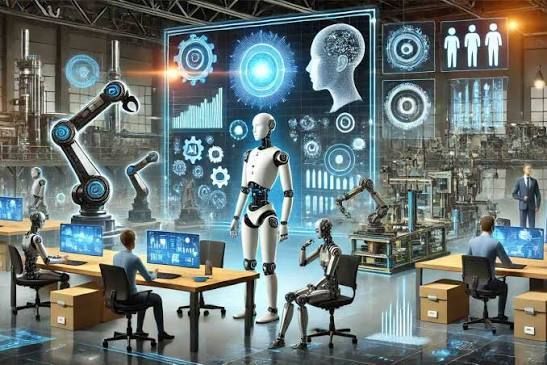
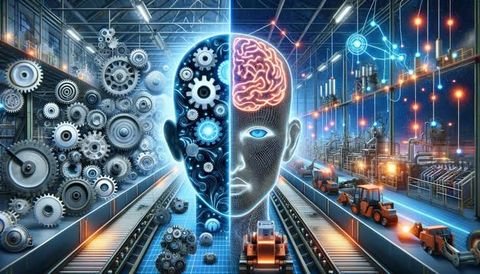
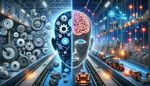
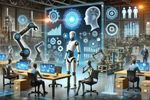
Traditional automation is highly effective when processes follow predictable rules. AI can extend these capabilities by helping automated systems work with complex data and changing production conditions.
Today, AI is being explored across manufacturing, quality inspection, predictive maintenance, robotics, supply chains, energy management and smart factories.
1. What Is AI in Industrial Automation?
AI in industrial automation refers to the use of artificial intelligence technologies within industrial machines, production systems and automated workflows.
A conventional automated process may follow:
Sensor Input → Fixed Rules → Machine Action
An AI-enabled system can introduce:
Sensor Input → Data Analysis → AI Prediction → Decision → Automated Action
This allows the system to identify patterns and make data-driven decisions within defined operational boundaries.
AI does not replace every conventional automation technology. Instead, it can add intelligence to existing industrial systems.
2. AI vs Traditional Industrial Automation
Traditional Automation
Traditional automation commonly uses:
-
Programmable logic controllers
-
Fixed control sequences
-
Sensors
-
Timers
-
Industrial control systems
-
Predefined rules
These technologies are particularly effective for repetitive and predictable processes.
AI-Enabled Automation
AI can add capabilities such as:
-
Pattern recognition
-
Prediction
-
Classification
-
Anomaly detection
-
Image analysis
-
Process optimisation
The two approaches can work together within the same production environment.
3. Key AI Technologies Used in Industrial Automation
Machine Learning
Machine learning allows systems to identify patterns from historical and real-time data.
Industrial applications include:
-
Predictive maintenance
-
Quality prediction
-
Process optimisation
-
Demand forecasting
Deep Learning
Deep learning uses multilayer neural networks to analyse complex datasets.
It is particularly useful for:
-
Image recognition
-
Defect detection
-
Complex classification
-
Advanced pattern recognition
Computer Vision
Computer vision enables machines to interpret images and video.
It can support:
-
Product inspection
-
Object recognition
-
Robot guidance
-
Assembly verification
-
Safety monitoring
Natural Language Processing
Natural language processing allows industrial software to interpret human language.
Potential applications include:
-
Technical document analysis
-
Equipment support interfaces
-
Maintenance documentation
-
Voice-based interaction
Reinforcement Learning
Reinforcement learning allows an AI system to learn decision strategies through feedback.
Research and industrial experimentation may use it for:
-
Process optimisation
-
Robotic control
-
Resource allocation
-
Dynamic scheduling
4. AI and Smart Manufacturing
Smart manufacturing connects machines, software, sensors and data systems into a more integrated production environment.
AI can analyse information from:
-
Production equipment
-
Sensors
-
Quality systems
-
Enterprise software
-
Supply-chain systems
-
Maintenance records
This creates a feedback loop between production activity and intelligent analysis.
5. AI-Powered Quality Inspection
Quality inspection is one of the most visible applications of AI in manufacturing.
A computer-vision system can capture product images and use trained models to identify patterns associated with defects.
A simplified workflow is:
Camera → Image Capture → AI Analysis → Classification → Inspection Decision
Possible inspection areas include:
-
Surface defects
-
Missing components
-
Incorrect assembly
-
Dimensional variations
-
Packaging issues
-
Colour or appearance differences
Performance depends on factors such as lighting, camera quality, training data and model design.
6. Predictive Maintenance
Predictive maintenance uses equipment data to identify patterns associated with potential failures.
Industrial systems can collect information such as:
-
Temperature
-
Vibration
-
Pressure
-
Current
-
Speed
-
Operating hours
-
Historical maintenance records
AI models can analyse these variables to identify unusual behaviour.
The objective is to support maintenance planning before a significant equipment failure occurs.
7. AI for Anomaly Detection
Anomaly detection focuses on identifying behaviour that differs from expected operating patterns.
For example, an AI system may identify an unusual combination of:
-
Increased vibration
-
Higher temperature
-
Changing motor current
Individually, each signal might appear normal. Combined analysis may indicate a developing problem.
This makes AI particularly useful for complex industrial environments with large amounts of sensor data.
8. AI in Industrial Robotics
Industrial robots traditionally perform programmed movements.
AI can add capabilities related to:
-
Visual perception
-
Object recognition
-
Adaptive motion
-
Path planning
-
Task classification
-
Dynamic environments
This can help robots handle greater variation in certain applications.
9. AI and Collaborative Robots
Collaborative robots, or cobots, are designed for applications where people and robots may operate in close proximity.
AI can support capabilities such as:
-
Vision-guided movement
-
Object identification
-
Adaptive task execution
-
Intelligent positioning
Actual safety depends on the complete system, application and validated safety configuration rather than AI alone.
10. AI-Powered Machine Vision
Machine vision combines cameras, lighting, image-processing technology and software.
AI can enhance machine vision by helping systems recognise complex visual patterns.
Potential applications include:
-
Assembly verification
-
Defect detection
-
Component identification
-
Robotic picking
-
Product classification
This technology is particularly valuable when manual inspection would be repetitive or difficult to standardise.
11. AI in Production Planning
Manufacturing environments involve multiple variables.
AI can analyse:
-
Production schedules
-
Machine availability
-
Material availability
-
Demand patterns
-
Processing times
-
Maintenance requirements
Intelligent scheduling systems can use these variables to identify more efficient production sequences.
12. AI for Process Optimisation
Industrial processes often involve multiple parameters that influence output.
AI can analyse relationships between:
-
Temperature
-
Pressure
-
Speed
-
Feed rate
-
Material characteristics
-
Production results
The system can then help identify operating conditions associated with desired outcomes.
13. AI in CNC Manufacturing
CNC machines already provide highly automated manufacturing.
AI can complement CNC operations through:
-
Tool-condition monitoring
-
Predictive maintenance
-
Automated inspection
-
Process optimisation
-
Tool-wear prediction
AI can analyse machine data and production results to identify patterns that may not be obvious through basic monitoring.
14. AI in Injection Molding
Injection molding involves numerous process variables.
AI can analyse factors such as:
-
Mold temperature
-
Injection pressure
-
Cycle time
-
Cooling conditions
-
Material characteristics
Applications can include:
-
Defect prediction
-
Process optimisation
-
Quality monitoring
-
Equipment maintenance
AI-based analysis can help manufacturers understand relationships between process parameters and product quality.
15. AI in Welding Automation
Automated welding systems can combine robotics with sensors and computer vision.
AI may support:
-
Weld inspection
-
Defect detection
-
Path optimisation
-
Process monitoring
-
Quality classification
The exact capabilities depend on the welding process and equipment architecture.
16. AI in Assembly Automation
Assembly lines can use AI to identify components and verify whether parts have been correctly positioned.
Applications include:
-
Component recognition
-
Assembly verification
-
Robotic picking
-
Error detection
-
Adaptive positioning
AI can be especially useful where products have multiple variants or configurations.
17. AI in Material Handling
AI-powered automation can support movement of materials throughout manufacturing environments.
Applications include:
-
Automated sorting
-
Robotic picking
-
Warehouse navigation
-
Inventory movement
-
Automated transport
Mobile robots can combine sensors, mapping technologies and AI-based navigation to operate within changing environments.
18. AI in Warehouse Automation
Modern warehouses increasingly combine physical automation with intelligent software.
Systems can include:
-
Automated storage and retrieval
-
Autonomous mobile robots
-
Machine vision
-
Inventory software
-
AI-based forecasting
AI can help determine which products should be moved, where they should be positioned and how workflows can be coordinated.
19. AI in Supply Chain Automation
Manufacturing depends on supply chains that can be affected by changing demand and supply conditions.
AI can support:
-
Demand forecasting
-
Inventory planning
-
Supplier analysis
-
Route optimisation
-
Disruption detection
The combination of AI and automation can connect planning decisions with physical logistics operations.
20. AI and Industrial IoT
Industrial Internet of Things systems connect machines and sensors to digital platforms.
A typical architecture can be represented as:
Sensors → Network → Data Platform → AI Model → Decision → Industrial Action
AI can analyse the large volumes of data generated by connected industrial equipment.
21. Edge AI in Manufacturing
Edge AI processes information closer to the machine or sensor.
This can be useful when applications require:
-
Low latency
-
Rapid response
-
Local processing
-
Reduced network dependency
For example, an inspection system may analyse an image locally and immediately flag a product for additional inspection.
22. Cloud AI in Industrial Automation
Cloud infrastructure can provide substantial computing and data-management capabilities.
Potential uses include:
-
Large-scale model training
-
Centralised analytics
-
Multi-site production monitoring
-
Historical data analysis
-
Enterprise-level reporting
Many industrial environments use combinations of edge and cloud technologies.
23. Digital Twins and AI
A digital twin is a digital representation of a physical asset, machine or process.
AI can use digital-twin data for:
-
Performance analysis
-
Predictive maintenance
-
Simulation
-
Process optimisation
-
Scenario testing
Manufacturers can use digital representations to study potential changes before implementing them in physical environments.
24. AI for Energy Management
Industrial facilities consume significant amounts of energy.
AI can analyse:
-
Electricity consumption
-
Machine utilisation
-
Production schedules
-
Temperature
-
Equipment performance
Applications can include:
-
Energy forecasting
-
Load optimisation
-
Equipment monitoring
-
Process efficiency analysis
25. AI in Industrial Safety
AI can support certain safety-monitoring applications.
Computer vision may identify situations such as:
-
Restricted-area access
-
Missing protective equipment
-
Unsafe positioning
-
Unusual movement patterns
However, AI-based safety systems should be carefully validated, and they should not automatically be treated as substitutes for established safety procedures.
26. AI for Worker Assistance
AI can also support industrial employees.
Examples include:
-
Digital maintenance assistants
-
Equipment information systems
-
Automated documentation
-
Technical knowledge retrieval
-
Voice interfaces
These tools can help workers access information while keeping human expertise central to operational decisions.
27. AI and Human-Machine Collaboration
The future of industrial automation is not necessarily about machines operating without people.
A more practical model is often:
Human Expertise + Automated Systems + AI Decision Support
Humans can provide:
-
Context
-
Experience
-
Oversight
-
Exception handling
-
Final judgement
AI can provide:
-
Data analysis
-
Pattern recognition
-
Prediction
-
Continuous monitoring
28. Benefits of AI in Industrial Automation
AI-enabled industrial systems can provide several potential benefits.
Improved Quality Monitoring
Automated inspection can analyse products consistently.
Predictive Capability
AI can identify patterns associated with potential equipment problems.
Faster Data Analysis
Large volumes of industrial data can be analysed more efficiently.
Process Optimisation
AI can help identify relationships between operating conditions and production outcomes.
Greater Visibility
Connected systems can provide more detailed information about equipment and processes.
Adaptive Automation
AI can help automated systems respond to changing conditions within defined limits.
29. Challenges of AI in Manufacturing
AI adoption also creates technical and organisational challenges.
Data Quality
Poor-quality data can reduce model accuracy.
Legacy Equipment
Older industrial machines may not have modern connectivity.
System Integration
Connecting AI platforms with industrial control systems can be complex.
Cybersecurity
Connected machinery creates additional cybersecurity considerations.
Model Reliability
AI predictions can be incorrect or affected by conditions not represented in training data.
Skills Gap
Industrial AI requires knowledge spanning engineering, data science, automation and cybersecurity.
30. AI and Industrial Cybersecurity
Connected industrial environments require strong cybersecurity practices.
Important areas can include:
-
Access control
-
Network segmentation
-
Device authentication
-
Software updates
-
Data protection
-
Monitoring
-
Backup systems
-
Incident response
Security should be considered during system architecture and deployment.
31. Data Quality in Industrial AI
Industrial AI systems depend on reliable data.
Important characteristics include:
-
Accuracy
-
Consistency
-
Completeness
-
Timeliness
-
Relevance
Training datasets should represent the real conditions in which the AI system will operate.
Changes in machines, materials or production processes can also affect model performance.
32. AI Model Monitoring
An AI model should not necessarily be treated as permanently accurate after deployment.
Industrial conditions can change because of:
-
Equipment ageing
-
New materials
-
Production changes
-
Environmental conditions
-
Product redesigns
Monitoring can help identify when model performance begins to change.
33. AI Architecture for Smart Factories
A smart-factory AI architecture can contain several layers.
Physical Layer
Machines, robots and sensors generate data.
Connectivity Layer
Industrial networks transfer information.
Data Layer
Information is collected, stored and prepared.
Intelligence Layer
AI models analyse data and produce predictions.
Automation Layer
Industrial systems respond according to defined logic.
Monitoring Layer
Performance, safety and operational results are evaluated.
This layered approach helps organisations understand how AI fits within existing automation infrastructure.
34. AI Implementation Strategy
A structured implementation process can reduce unnecessary complexity.
Step 1: Identify the Problem
Start with a measurable industrial challenge.
Step 2: Assess Available Data
Determine whether sufficient historical and real-time data exists.
Step 3: Evaluate Existing Equipment
Review machines, sensors, networks and control systems.
Step 4: Define Success Metrics
Examples include:
-
Inspection accuracy
-
Downtime reduction
-
Prediction accuracy
-
Processing time
-
Quality consistency
Step 5: Run a Pilot
Test the technology in a controlled environment.
Step 6: Validate Performance
Compare results against established processes.
Step 7: Scale Carefully
Expand the solution after confirming reliability and operational suitability.
35. When AI May Not Be Necessary
Not every industrial process requires artificial intelligence.
Conventional automation may be more appropriate when:
-
Conditions are highly predictable
-
Rules are simple
-
Data volumes are limited
-
The process is already reliable
-
AI would add unnecessary complexity
The goal should be to select the appropriate technology for the specific industrial problem.
36. Future Trends in Industrial AI
More Intelligent Robots
Robots are becoming increasingly capable of perception and adaptive task execution.
Advanced Machine Vision
AI-based vision systems are likely to become more capable of recognising complex defects and variations.
Autonomous Mobile Robots
Mobile robots may become increasingly integrated into manufacturing and warehouse environments.
Digital Twins
AI-powered digital twins can support more detailed simulation and process optimisation.
Edge Intelligence
More industrial AI processing may occur directly near machines and sensors.
Generative AI
Generative AI may increasingly support maintenance documentation, technical information retrieval and human-machine interaction.
AI Agents
Agent-based systems may eventually coordinate multi-step industrial workflows under defined permissions and oversight.
37. AI in Industry 4.0
AI is one of the technologies associated with Industry 4.0.
Other technologies include:
-
Industrial IoT
-
Robotics
-
Cloud computing
-
Edge computing
-
Digital twins
-
Advanced analytics
-
Cybersecurity
-
Additive manufacturing
Together, these technologies are contributing to increasingly connected industrial environments.
38. Practical AI Automation Checklist
Before implementing an AI-enabled industrial system, organisations can consider:
Process
-
What problem needs to be solved?
-
Is the process suitable for AI?
Data
-
Is sufficient data available?
-
Is the data reliable?
Equipment
-
Can existing machinery provide relevant information?
-
Are sensors and connectivity available?
Technology
-
Is machine learning required?
-
Would computer vision be more appropriate?
-
Should processing happen at the edge or in the cloud?
Safety
-
What happens if the AI makes an incorrect prediction?
-
What human oversight is required?
Security
-
How will connected systems be protected?
-
Who can access the data and controls?
Maintenance
-
How will AI models and industrial equipment be monitored?
FAQs
What is AI in industrial automation?
AI in industrial automation combines artificial intelligence with machines, sensors, robotics and industrial software to support tasks such as prediction, inspection, anomaly detection and process optimisation.
How is AI used in manufacturing?
AI can be used for quality inspection, predictive maintenance, production planning, machine vision, robotics, process optimisation, inventory management and energy analysis.
What technologies are used in industrial AI?
Common technologies include machine learning, deep learning, computer vision, robotics, Industrial IoT, edge computing, cloud computing and digital twins.
Can AI replace traditional industrial automation?
AI generally complements rather than completely replaces traditional automation. Fixed-rule automation remains highly effective for predictable processes, while AI can add capabilities such as prediction and pattern recognition.
What are the biggest challenges of industrial AI?
Common challenges include data quality, legacy equipment, system integration, cybersecurity, model reliability, workforce skills and ongoing AI-model monitoring.
Conclusion
AI in industrial automation is helping manufacturers move from purely rule-based systems toward more data-driven, predictive and adaptive operations.
Machine learning can analyse equipment data, computer vision can support quality inspection, robotics can become more adaptive, and Industrial IoT can connect machines across production environments.
However, successful implementation requires more than an AI model. Reliable data, suitable equipment, cybersecurity, system integration, safety controls, skilled personnel and continuous monitoring are equally important.
The future of industrial automation is likely to combine traditional control technologies with AI, robotics, connected sensors, digital twins and intelligent software. The result will be industrial environments that can better understand operational conditions, identify patterns and support faster, more informed decisions.
Disclaimer
This article is intended for general educational and informational purposes only. Industrial automation systems, AI technologies, machinery and safety requirements vary by application and operating environment. The information provided does not constitute engineering, technical, industrial safety, cybersecurity or professional advice and does not recommend any particular manufacturer, system or technology. Organisations should evaluate applicable standards, regulations, equipment documentation, cybersecurity requirements and professional guidance before implementing AI-enabled industrial automation.