
What You Should Know About AI Voice Automation for Modern Businesses
Artificial intelligence is transforming how businesses communicate with customers, employees, and partners. One of the fastest-growing innovations is AI Voice Automation, which enables organizations to automate voice-based interactions while improving efficiency, availability, and customer experiences.
From answering routine inquiries to routing calls and providing self-service options, AI-powered voice systems are becoming an important part of modern business operations.
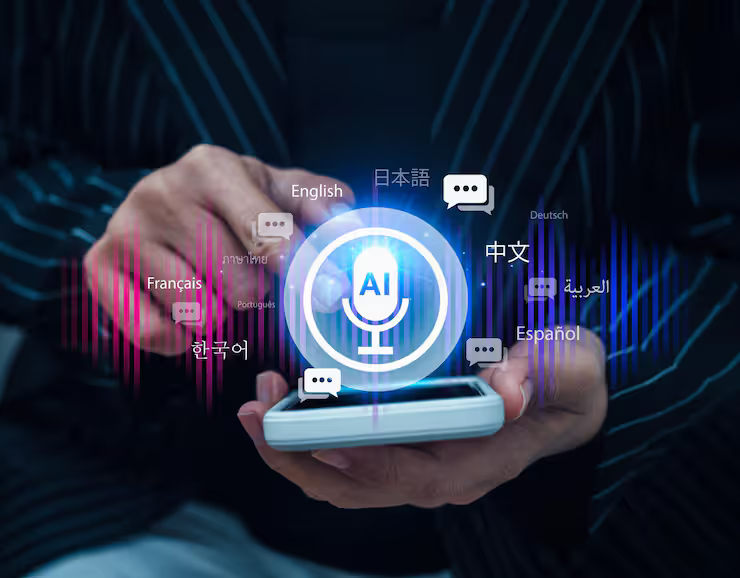
Advances in natural language processing (NLP), speech recognition, machine learning, and cloud computing have made voice automation more accurate and accessible for businesses of all sizes. Understanding how AI voice automation works, its business applications, and implementation considerations can help organizations evaluate whether the technology aligns with their operational goals.
This guide explains AI Voice Automation, its key components, business benefits, common applications, implementation best practices, and future trends.
Note: Features, accuracy, language support, integrations, pricing, and regulatory requirements vary by technology provider and implementation. This article is intended for general educational purposes only.
What Is AI Voice Automation?
AI Voice Automation refers to the use of artificial intelligence technologies to understand, process, and respond to spoken language without requiring continuous human intervention. These systems can recognize speech, interpret user intent, generate appropriate responses, and complete predefined tasks through voice interactions.
Common capabilities include:
Voice-based customer support
Call routing
Appointment scheduling
Order status updates
Frequently asked question (FAQ) responses
Voice authentication in supported systems
Internal employee assistance
Multilingual communication where available
The functionality depends on the software platform and business requirements.
How AI Voice Automation Works
Modern voice automation combines several AI technologies.
Speech Recognition
Converts spoken language into text that the system can process.
Natural Language Processing (NLP)
Analyzes words, context, and user intent to understand requests more accurately.
Machine Learning
Improves system performance over time by learning from interactions and updated training data.
Text-to-Speech (TTS)
Transforms generated responses into natural-sounding spoken communication.
Workflow Automation
Connects voice interactions with business systems to complete tasks such as scheduling, customer verification, or information retrieval.
Benefits for Modern Businesses
AI voice automation can support operational efficiency across many industries.
Potential benefits include:
Faster response times
24/7 customer availability
Consistent communication
Reduced handling of repetitive inquiries
Improved call routing
Better scalability during peak demand
Integration with existing business systems
Enhanced customer self-service options
Results vary depending on implementation quality and business processes.
Common Business Applications
Organizations use AI voice automation in a wide range of scenarios.
Customer Service
Handle common questions, provide account information, and route callers to the appropriate department.
Appointment Scheduling
Assist customers with booking, changing, or confirming appointments.
Sales Support
Provide product information and qualify customer inquiries before transferring to sales teams.
Healthcare
Help manage appointment reminders, patient information requests, and call routing while complying with applicable privacy regulations.
Banking and Financial Services
Support account inquiries, balance information, and transaction guidance using secure authentication methods where available.
Human Resources
Answer employee questions about company policies, benefits, or leave procedures.
Industries Using AI Voice Automation
The technology is widely adopted across different sectors.
Examples include:
Retail
Healthcare
Banking
Insurance
Hospitality
Telecommunications
Logistics
Government services
Education
E-commerce
Each industry customizes voice automation based on its operational needs.
Implementation Considerations
Successful deployment requires thoughtful planning.
Businesses should consider:
Integration with existing systems
Data privacy and security
Language and accent support
Call escalation to human agents
Customer experience design
Regulatory compliance
Performance monitoring
Ongoing system updates
A structured implementation strategy helps improve long-term performance.
AI Voice Automation Overview
| Feature | Primary Purpose |
|---|---|
| Speech Recognition | Convert speech into text |
| Natural Language Processing | Understand user intent |
| Machine Learning | Improve response accuracy |
| Text-to-Speech | Deliver spoken responses |
| Workflow Integration | Automate business processes |
| Analytics Dashboard | Measure performance and usage |
Best Practices
Organizations can improve results by following proven practices.
Helpful recommendations include:
Define clear automation objectives.
Keep conversations simple and natural.
Provide an easy option to reach a human representative.
Monitor system performance regularly.
Update knowledge bases frequently.
Test voice interactions with real users.
Protect customer data using appropriate security measures.
Review analytics to identify opportunities for improvement.
Continuous optimization supports better user experiences.
Current Industry Trends
AI voice technology continues to evolve rapidly.
Recent developments include:
Generative AI-powered conversations
Real-time multilingual voice assistance
Emotion and sentiment analysis
Voice biometrics for secure authentication
Cloud-native voice platforms
Predictive customer support
Omnichannel communication integration
AI-powered conversational analytics
These innovations are making voice automation more intelligent, personalized, and efficient.
Looking Ahead
The future of AI Voice Automation is expected to include more natural conversations, stronger multilingual capabilities, improved contextual understanding, and deeper integration with enterprise software. As artificial intelligence continues to advance, voice automation will likely become an even more valuable tool for improving customer experiences and streamlining business operations.
Why Understanding AI Voice Automation Matters
Understanding AI Voice Automation helps businesses evaluate emerging technologies, improve communication workflows, and identify opportunities to automate repetitive voice interactions. Careful planning, thoughtful implementation, and continuous monitoring can help organizations maximize the value of AI-powered voice solutions.
Conclusion
AI Voice Automation is transforming how businesses communicate by combining speech recognition, natural language processing, machine learning, and workflow automation into intelligent voice-based systems. From customer support and appointment scheduling to internal employee assistance and sales inquiries, AI voice technology offers flexible solutions across many industries. By understanding its capabilities, implementation considerations, and future trends, organizations can make informed decisions about adopting voice automation as part of their digital transformation strategy.