Industrial Robotic Arms Guide: Technology, Benefits, and Industrial Uses
Industrial robotic arms are programmable machines used to automate physical tasks. They can move, position, handle, assemble, and process materials with controlled precision.
Modern industrial robotic arms combine mechanical joints, sensors, controllers, and end effectors. They support repetitive and complex operations across many manufacturing environments.
Quick Answer: What Are Industrial Robotic Arms?
- Industrial robotic arms are programmable machines designed for automated physical tasks.
- Their articulated joints imitate several movements of a human arm.
- Controllers coordinate position, speed, direction, and movement sequences.
- End effectors allow robots to grip, weld, inspect, or process materials.
- Sensors provide information about position and surrounding conditions.
- Common applications include welding, assembly, handling, and machine tending.
- Modern robotic systems increasingly use vision and intelligent automation.
What Are Industrial Robotic Arms?
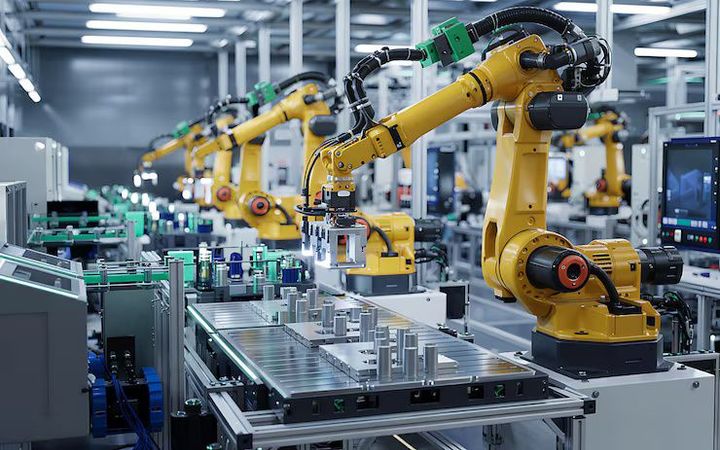
Industrial robotic arms are automated mechanical systems with multiple movable joints.
Their structure typically includes a base, links, joints, motors, sensors, and tooling. A programmable controller coordinates these components.
Industrial robots can perform tasks requiring:
- Repetitive motion
- Precise positioning
- Material movement
- Controlled assembly
- Welding
- Cutting
- Machine tending
- Inspection
- Packaging
- Surface processing
Different robotic configurations support different operating requirements.
How Do Industrial Robotic Arms Work?
Industrial robotic arms operate through coordinated mechanical and electronic systems.
The controller sends commands to individual joints. Motors then move those joints into programmed positions.
How Does the Robot Controller Manage Movement?
The robot controller acts as the central processing unit.
It interprets programmed instructions and coordinates every axis.
The controller can manage:
- Joint position
- Movement direction
- Speed
- Acceleration
- Tool orientation
- Operating sequences
- Sensor information
Accurate coordination creates smooth robotic motion.
How Do Robot Joints Create Movement?
Robot arms contain multiple joints called axes.
Each axis provides a particular movement.
Common movements include:
- Rotation
- Extension
- Vertical movement
- Horizontal movement
- Wrist rotation
- Tool positioning
A six-axis robot provides extensive movement flexibility.
What Are the Main Components of an Industrial Robotic Arm?
Several components work together during robotic operation.
What Is the Robot Base?
The base supports the complete robotic structure.
It provides stability while the robot moves through its working area.
What Are Robotic Links and Joints?
Links are rigid structural sections of the robot.
Joints connect these sections and allow controlled movement.
Together, they determine the robot's range of motion.
What Are Robot Actuators?
Actuators create physical movement.
Industrial robots commonly use electric servo motors. Some specialized systems use hydraulic or pneumatic actuation.
What Is an End Effector?
An end effector is attached to the robot's final joint.
It performs the actual manufacturing task.
Examples include:
- Grippers
- Welding equipment
- Cutting tools
- Vacuum systems
- Inspection sensors
- Dispensing equipment
- Polishing tools
Changing the end effector can change the robot's function.
What Do Robotic Sensors Do?
Sensors provide information about the robot and its environment.
They may measure:
- Position
- Force
- Torque
- Distance
- Pressure
- Object presence
- Temperature
Sensor feedback improves control and process awareness.
What Are the Main Types of Industrial Robotic Arms?
Industrial robots use several mechanical configurations.
How Do Articulated Robots Work?
Articulated robots contain several rotary joints.
Six-axis articulated robots are common in manufacturing. Their structure provides extensive movement flexibility.
Typical applications include:
- Welding
- Assembly
- Material handling
- Machine tending
- Surface finishing
What Are SCARA Robots?
SCARA robots provide fast horizontal movement with controlled vertical motion.
SCARA stands for Selective Compliance Assembly Robot Arm.
They are commonly used for:
- Component assembly
- Part transfer
- Electronics handling
- Packaging
- Pick-and-place operations
How Do Cartesian Robots Work?
Cartesian robots move along straight linear axes.
Their movement usually follows X, Y, and Z coordinates.
Common applications include:
- Material positioning
- Machine loading
- Dispensing
- Automated handling
- Precision movement
What Are Delta Robots?
Delta robots use lightweight parallel arms connected to a common base.
Their structure enables rapid movement.
Typical uses include:
- Sorting
- Packaging
- Product handling
- High-speed pick-and-place tasks
What Are Collaborative Robotic Arms?
Collaborative robots, often called cobots, are designed for controlled human-robot interaction.
They can include safety features such as:
- Force limitation
- Speed monitoring
- Collision detection
- Safety-rated motion controls
Risk assessment remains necessary for collaborative applications.
What Is a Robot's Payload Capacity?
Payload capacity describes the mass a robotic arm can safely handle.
The total payload can include:
- Workpiece
- Gripper
- Tooling
- Sensors
- Additional attachments
Exceeding specified limits can affect accuracy and machine performance.
What Is the Working Envelope of a Robotic Arm?
The working envelope describes the space a robot can physically reach.
Robot geometry determines its working envelope.
Important factors include:
- Arm length
- Number of axes
- Joint movement limits
- Installation position
- Tool dimensions
Understanding reach is important during robotic cell design.
What Does Robot Repeatability Mean?
Repeatability describes how consistently a robot returns to the same programmed position.
High repeatability is important for repetitive manufacturing tasks.
Applications requiring strong repeatability include:
- Assembly
- Welding
- Component placement
- Machine tending
- Inspection
Repeatability differs from absolute positioning accuracy.
How Are Industrial Robotic Arms Programmed?
Robot programming defines movement and task sequences.
Programming approaches can include:
- Teach pendant programming
- Offline programming
- Graphical programming
- Hand-guided teaching
- Automated path generation
The selected method depends on robot design and application complexity.
How Does Machine Vision Work With Robotic Arms?
Machine vision systems provide visual information to robotic controllers.
Cameras capture images from the working environment. Vision processing identifies relevant objects or features.
Vision-guided robots can perform:
- Object detection
- Component identification
- Position recognition
- Orientation detection
- Inspection
- Sorting
- Robotic guidance
Machine vision increases robotic adaptability.
How Are Industrial Robotic Arms Used for Material Handling?
Material handling is a major robotic application.
Robots can repeatedly transfer components between defined locations.
Typical operations include:
- Pick and place
- Loading
- Unloading
- Palletizing
- Sorting
- Component transfer
Automated handling can reduce repetitive manual movement.
How Are Robotic Arms Used for Welding?
Industrial robots are widely used for automated welding.
The robot follows programmed paths while maintaining controlled movement.
Robotic welding can support:
- Arc welding
- Spot welding
- Laser welding
- Specialized joining processes
Consistent movement supports repeatable weld placement.
How Are Robotic Arms Used for Assembly?
Assembly robots position and connect manufacturing components.
Applications include:
- Component insertion
- Screwdriving
- Fastening
- Press fitting
- Electronic assembly
- Mechanical assembly
Sensors can verify positioning during these operations.
How Do Robots Support Machine Tending?
Machine tending robots interact with manufacturing equipment.
They can:
- Load workpieces
- Remove completed components
- Reposition materials
- Transfer parts
- Support automated production sequences
Machine tending is common around CNC equipment and other processing machinery.
Which Industries Use Industrial Robotic Arms?
Industrial robotic arms operate across many sectors.
Common examples include:
- Automotive manufacturing
- Aerospace engineering
- Electronics manufacturing
- Metal fabrication
- Machinery production
- Food processing
- Packaging
- Pharmaceutical manufacturing
- Plastics processing
- Warehousing
- General engineering
Robot configuration varies according to the task and environment.
What Are the Main Benefits of Industrial Robotic Arms?
Robotic automation provides several operational advantages.
Important benefits include:
- Consistent repetitive movement
- High repeatability
- Controlled positioning
- Continuous process automation
- Flexible programming
- Reduced exposure to hazardous tasks
- Improved process consistency
- Integration with digital manufacturing systems
Actual performance depends on system design and application.
How Do Industrial Robotic Arms Improve Workplace Safety?
Robots can perform tasks involving challenging operating conditions.
Examples include:
- High temperatures
- Repetitive lifting
- Welding environments
- Sharp materials
- Heavy components
- Hazardous processing areas
However, robotic equipment creates its own hazards.
Proper guarding and safety controls remain essential.
What Safety Technologies Are Used With Industrial Robots?
Industrial robot cells can contain several safety technologies.
Examples include:
- Physical barriers
- Interlocked guards
- Emergency stop systems
- Safety scanners
- Light curtains
- Presence detection
- Speed monitoring
- Force monitoring
- Safety-rated controllers
The appropriate safeguards depend on a formal risk assessment.
How Are Industrial Robotic Arms Maintained?
Routine maintenance supports reliable robotic operation.
Typical activities include:
- Inspecting joints
- Checking cables
- Examining end effectors
- Monitoring lubrication
- Testing safety equipment
- Checking sensor operation
- Inspecting mounting points
- Reviewing controller diagnostics
- Monitoring movement accuracy
Maintenance requirements vary by robotic system.
How Are AI and Smart Technologies Changing Industrial Robotics?
Industrial robotics continues to evolve through intelligent automation.
Modern developments include:
- AI-assisted machine vision
- Adaptive motion planning
- Advanced sensor fusion
- Predictive maintenance
- Digital twins
- Automated quality inspection
- Condition monitoring
- Connected manufacturing systems
- Data-driven process optimization
These technologies help robotic systems respond to more complex production environments.
What Should Be Considered When Planning Robotic Automation?
Successful robotic integration requires careful planning.
Important considerations include:
- Required payload
- Robot reach
- Number of axes
- Cycle requirements
- End-effector design
- Positioning requirements
- Working environment
- Safety requirements
- Machine integration
- Maintenance access
The complete robotic cell should be considered as one integrated system.
Frequently Asked Questions
What is an industrial robotic arm?
An industrial robotic arm is a programmable machine designed for automated physical operations.
How many axes can an industrial robotic arm have?
The number varies by design. Six-axis articulated robots are widely used in manufacturing.
What tasks can robotic arms perform?
They can support welding, assembly, handling, inspection, packaging, and machine tending.
What is an end effector?
An end effector is the tool attached to the robot's final joint.
What is robot repeatability?
Repeatability describes how consistently a robot returns to a programmed position.
Can industrial robots use machine vision?
Yes. Cameras and vision processing can help robots locate and inspect objects.
Key Takeaways
Industrial Robotic Arms Summary
- Industrial robotic arms automate physical manufacturing operations.
- Controllers coordinate robot movement, position, speed, and task sequences.
- Joints and links create the robot's range of motion.
- End effectors allow robots to perform specialized operations.
- Articulated, SCARA, Cartesian, and delta robots have different structures.
- Machine vision helps robots identify and locate components.
- Robotic arms support welding, assembly, handling, and machine tending.
- Safety systems are essential around industrial robotic equipment.
- Sensors provide important feedback during automated operations.
- AI, machine vision, and digital monitoring continue advancing industrial robotics.