Hydraulic Press Machines and Industrial Metal Forming Systems Explained: Learn Operation Basics, Safety Tips, Process Insights, and Technical Knowledge
A hydraulic press machine is an industrial machine that uses hydraulic pressure to generate controlled force for shaping, compressing, bending, stamping, forging, and assembling metal components.
Understanding Hydraulic Press Machines and Industrial Metal Forming Systems
Modern industrial hydraulic press systems are widely used in manufacturing because they provide consistent force, high precision, and efficient operation across a wide range of production environments.
The development of industrial metal forming systems has helped industries produce stronger and more accurate components while improving workplace efficiency. From automotive manufacturing to aerospace engineering and heavy equipment production, these systems support many essential industrial processes.
Today's hydraulic press equipment often includes digital controls, programmable interfaces, sensors, and automation technologies that improve operational accuracy and process monitoring. Many production facilities also integrate industrial press automation with robotic handling systems and quality inspection technologies.
Why Hydraulic Press Technology Matters Today
Modern manufacturing requires reliable equipment capable of producing consistent results. A heavy duty hydraulic press provides the force needed for large industrial components while maintaining dimensional accuracy throughout production.
Industries benefiting from hydraulic press technology include:
- Automotive manufacturing
- Aerospace engineering
- Railway equipment production
- Construction machinery
- Electrical equipment manufacturing
- Appliance manufacturing
- Metal fabrication workshops
- Industrial research facilities
Hydraulic systems help address several manufacturing challenges:
| Manufacturing Challenge | Hydraulic Press Contribution |
|---|---|
| High forming force requirements | Generates controlled hydraulic pressure |
| Consistent product quality | Maintains repeatable pressing cycles |
| Complex metal shaping | Supports precision forming operations |
| Material waste reduction | Improves production accuracy |
| Worker safety | Uses enclosed safety systems and automated controls |
| Production monitoring | Integrates digital control systems |
The increasing adoption of hydraulic press automation allows manufacturers to improve productivity while reducing manual handling during repetitive forming operations.
Common Types of Hydraulic Press Machines
Various metal forming machines are designed for different industrial applications. The selection depends on material type, production volume, force requirements, and manufacturing objectives.
C-Frame Hydraulic Press
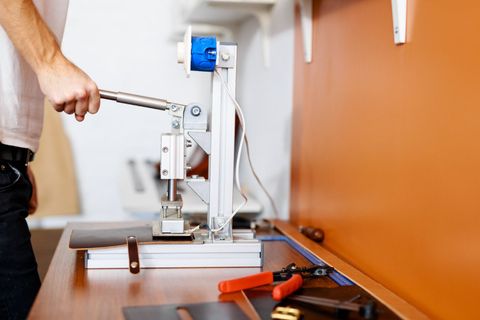
Designed for smaller workpieces, this press provides easy access to the working area and is commonly used for assembly, punching, and laboratory applications.
H-Frame Hydraulic Press
One of the most common industrial press machine designs, the H-frame configuration provides excellent structural strength for heavy-duty pressing and maintenance work.
Four-Column Hydraulic Press
This design distributes force evenly across large workpieces and is frequently used for deep drawing, molding, and composite forming applications.
Hydraulic Forging Press
A hydraulic forging press gradually applies pressure to shape heated metal into durable industrial components used in transportation, energy, and infrastructure.
Hydraulic Stamping Press
A hydraulic stamping press forms sheet metal into precise shapes using specialized dies and controlled hydraulic pressure.
CNC Hydraulic Press
A CNC hydraulic press integrates computer numerical control for automated positioning, programmable pressing cycles, and repeatable manufacturing processes.
Sheet Metal Forming Machine
A sheet metal forming machine performs bending, deep drawing, embossing, flanging, and forming operations for thin metal sheets used across multiple industries.
Benefits and Industrial Applications
Modern industrial forging equipment provides several technical advantages when integrated into manufacturing environments.
Key Benefits
- High force generation with controlled pressure
- Accurate and repeatable forming operations
- Compatibility with different metal materials
- Reduced mechanical vibration compared to some mechanical presses
- Integration with automated production lines
- Improved monitoring through digital control systems
- Enhanced workplace safety using protective guarding and sensors
Common Applications
| Industry | Typical Application |
|---|---|
| Automotive | Body panels, chassis parts, gears |
| Aerospace | Structural components and precision alloys |
| Construction | Steel brackets and heavy equipment parts |
| Electronics | Metal housings and connectors |
| Medical Equipment | Precision metal components |
| Agriculture | Machinery frames and equipment parts |
| Energy | Turbine components and industrial fittings |
| Shipbuilding | Heavy structural metal fabrication |
Many metal fabrication equipment installations combine hydraulic presses with robotic handling systems, laser measurement tools, and automated inspection technologies to improve production consistency.
Leading Hydraulic Press Manufacturers
Several globally recognized hydraulic press manufacturers have extensive experience in industrial press technology and metal forming equipment.
| Company | Headquarters | Primary Focus |
|---|---|---|
| Schuler Group | Germany | Press systems and forming technology |
| SMS Group | Germany | Heavy industrial metal forming equipment |
| Komatsu Industries | Japan | Servo and hydraulic press solutions |
| Macrodyne Technologies | Canada | Large hydraulic press systems |
| Beckwood Press Company | United States | Custom hydraulic press equipment |
These companies contribute to ongoing advancements in industrial hydraulic press, industrial forging equipment, automation systems, and digital manufacturing technologies.
Recent Developments and Industry Trends
During 2025 and early 2026, industrial manufacturers have continued investing in smarter production technologies and energy-efficient equipment.
Several notable trends include:
- Increased adoption of Industry 4.0 manufacturing systems.
- Greater integration of Artificial Intelligence for predictive maintenance.
- Expansion of Industrial Internet of Things (IIoT) sensors for equipment monitoring.
- Improved hydraulic systems designed to reduce energy consumption.
- Growth in robotic loading and unloading for automated production cells.
- More digital dashboards for monitoring hydraulic pressure, cycle times, and machine health.
- Increased use of simulation software before manufacturing begins.
Manufacturers are also focusing on sustainability by improving hydraulic fluid management, reducing material waste, and increasing machine efficiency throughout production cycles.
Regulations and Industrial Standards
Hydraulic press operations are affected by workplace safety regulations and industrial standards that vary by country.
Some commonly referenced regulations include:
-
United States
- OSHA machine guarding requirements
- ANSI safety standards for machinery
- NFPA electrical safety guidance
-
European Union
- Machinery Regulation and CE conformity requirements
- EN safety standards for industrial machinery
-
India
- Occupational Safety, Health and Working Conditions Code
- Bureau of Indian Standards (BIS) technical standards where applicable
- Factory safety rules administered by state authorities
Organizations operating industrial press automation systems generally follow documented maintenance procedures, operator training programs, emergency stop testing, lockout/tagout procedures, and periodic equipment inspections.
Helpful Tools and Technical Resources
Engineers, students, technicians, and manufacturers often use various technical resources when working with hydraulic machine suppliers and industrial press systems.
Useful resources include:
- CAD software for press tooling design
- Finite Element Analysis (FEA) simulation software
- Hydraulic pressure calculators
- Material property databases
- Industrial maintenance management software
- PLC programming platforms
- CNC programming software
- Equipment maintenance checklists
- Preventive maintenance templates
- Engineering standards documentation
These resources support equipment planning, maintenance scheduling, production optimization, and technical education.
Frequently Asked Questions
What is the working principle of a hydraulic press machine?
A hydraulic press machine operates according to Pascal's Law. Pressure applied to hydraulic fluid is transmitted evenly throughout the system, allowing a relatively small input force to generate a much larger output force through hydraulic cylinders.
What materials can be processed using hydraulic presses?
Hydraulic presses commonly process steel, aluminum, stainless steel, copper, brass, titanium, composite materials, and certain engineered plastics depending on machine configuration.
Why is a CNC hydraulic press different from a conventional press?
A CNC hydraulic press uses computer-controlled programming to automate positioning, pressure settings, cycle timing, and repeatable production sequences, improving consistency and reducing manual adjustments.
How does industrial press automation improve manufacturing?
Automation enables robotic material handling, programmable production cycles, real-time monitoring, quality inspection, and predictive maintenance, which help improve operational consistency and production efficiency.
What safety practices should operators follow?
Operators should wear appropriate personal protective equipment, verify machine guards before operation, follow lockout/tagout procedures during maintenance, inspect hydraulic systems regularly, and receive proper equipment training before operating industrial machinery.
Conclusion
Hydraulic press technology remains one of the most important foundations of modern manufacturing. From small workshop equipment to massive heavy duty hydraulic press installations, these systems enable reliable metal forming across automotive, aerospace, construction, energy, and industrial manufacturing sectors.
Continuous improvements in industrial press automation, intelligent monitoring, digital controls, and industrial metal forming systems are making manufacturing more precise, efficient, and safer than previous generations of equipment. As Industry 4.0 technologies continue to evolve, hydraulic press systems are increasingly integrated with robotics, sensors, and predictive maintenance platforms that support higher productivity and improved operational reliability.
Understanding the operation, types, applications, safety practices, regulations, and technological developments surrounding hydraulic press machine, industrial hydraulic press, metal forming machines, hydraulic forging press, sheet metal forming machine, hydraulic stamping press, CNC hydraulic press, metal fabrication equipment, and hydraulic machine suppliers provides valuable technical knowledge for students, engineers, technicians, researchers, and anyone interested in modern industrial manufacturing.
Informational Disclaimer
This article is provided for educational and informational purposes only. Technical specifications, production capacities, equipment configurations, estimated pricing ranges, industrial packages, and regulatory requirements may vary by manufacturer, machine model, country, and project requirements. Always refer to current manufacturer documentation, applicable safety regulations, and relevant engineering standards before selecting, operating, or maintaining industrial hydraulic press equipment.