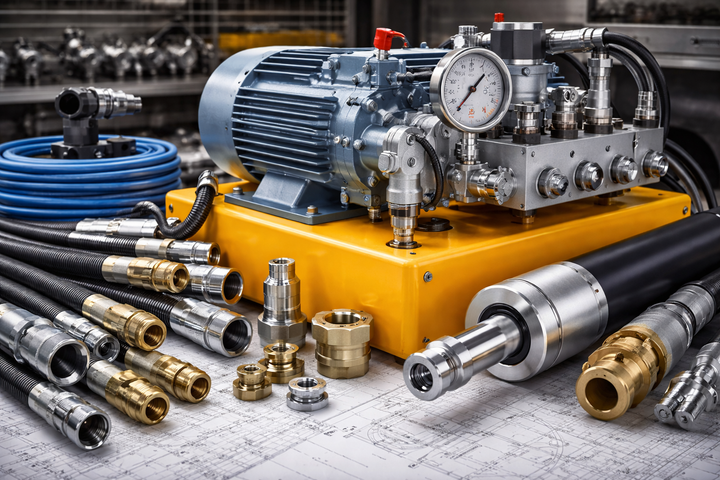
Hydraulic power systems are technologies that use fluid pressure to generate, control, and transmit energy. These systems rely on liquids—typically oil or water—because liquids are nearly incompressible, making them efficient for transferring force over distances.
The concept behind hydraulics dates back centuries, but modern hydraulic systems are widely used in industries such as construction, manufacturing, agriculture, and transportation. You will find hydraulic mechanisms in machines like excavators, elevators, car braking systems, and aircraft controls.
At a basic level, hydraulic systems operate using Pascal’s principle, which states that pressure applied to a confined fluid is transmitted equally in all directions. This allows small forces to be amplified into much larger ones, enabling heavy lifting and precise control.
Hydraulic power systems exist because many industrial and mechanical tasks require high force output combined with smooth, controlled motion. Mechanical or electrical systems alone may not always provide the same efficiency, especially when dealing with heavy loads or harsh environments.
Why Hydraulic Power Systems Matter Today
Hydraulic systems play a critical role in modern infrastructure and industrial processes. They are essential in sectors that depend on reliable force transmission and precise control.
These systems matter today because they help:
-
Enable heavy machinery operations in construction and mining
-
Support automated manufacturing processes
-
Improve safety in transportation systems (e.g., braking systems)
-
Increase efficiency in agricultural equipment
The impact extends across multiple stakeholders:
-
Engineers and technicians rely on hydraulics for system design and maintenance
-
Industries depend on them for productivity and operational efficiency
-
Governments and infrastructure projects use hydraulic systems for large-scale development
Hydraulic systems solve several key problems:
-
Force multiplication: Lifting heavy loads with minimal input force
-
Precision control: Smooth and accurate movement in machines
-
Durability: Ability to operate in extreme conditions such as high pressure and temperature
-
Compact design: Delivering high power in relatively small systems
As industries move toward automation and energy efficiency, hydraulic systems continue to evolve, integrating with digital controls and smart monitoring technologies.
Key Components of Hydraulic Systems
Understanding the main components helps clarify how hydraulic systems function as a whole.
Core components include:
-
Hydraulic Pump: Converts mechanical energy into hydraulic energy by moving fluid
-
Hydraulic Fluid: The medium that transmits power
-
Reservoir: Stores the hydraulic fluid
-
Valves: Control the flow and pressure of the fluid
-
Actuators (Cylinders and Motors): Convert hydraulic energy back into mechanical motion
-
Filters: Remove contaminants to maintain system efficiency
-
Pipes and Hoses: Transport fluid between components
Below is a simple overview table:
| Component | Function | Example Use Case |
|---|
| Hydraulic Pump | Generates fluid flow | Excavator systems |
| Control Valves | Regulate pressure and direction | Industrial automation |
| Actuators | Produce movement | Hydraulic lifts |
| Reservoir | Stores fluid | All hydraulic systems |
| Filters | Maintain fluid cleanliness | Manufacturing plants |
Practical Applications Across Industries
Hydraulic power systems are widely used because of their versatility and reliability.
Common applications include:
-
Construction Equipment: Excavators, loaders, cranes
-
Automotive Systems: Brakes, steering systems
-
Aviation: Landing gear and flight control systems
-
Manufacturing: Press machines, robotic arms
-
Agriculture: Tractors, harvesters
A simple representation of hydraulic force amplification:
| Input Force (N) | Output Force (N) | Application Example |
|---|
| 100 | 1,000 | Car lift |
| 200 | 2,000 | Hydraulic press |
| 500 | 5,000 | Industrial machinery |
This ability to multiply force efficiently makes hydraulics indispensable in heavy-duty operations.
Recent Developments and Industry Trends
Hydraulic technology has seen notable changes in recent years, especially between 2024 and early 2026.
Key trends include:
-
Electro-hydraulic systems: Integration with electronic controls for better precision and automation
-
Energy-efficient designs: Systems that reduce power consumption and heat loss
-
Smart monitoring: Use of sensors and IoT for predictive maintenance
-
Eco-friendly fluids: Development of biodegradable hydraulic fluids
In 2025, several manufacturers introduced digitally controlled hydraulic systems that allow real-time performance monitoring. These systems help reduce downtime and improve operational safety.
Another significant update is the growing use of simulation software to design hydraulic circuits before physical implementation. This reduces errors and enhances system efficiency.
The shift toward sustainability is also influencing hydraulic system design, with industries adopting low-emission and energy-saving technologies.
Laws, Regulations, and Standards
Hydraulic power systems are subject to various regulations to ensure safety, environmental protection, and efficiency. These rules vary by country but share common goals.
In India, hydraulic systems are influenced by:
-
Bureau of Indian Standards (BIS): Provides guidelines for safety and quality
-
Factories Act, 1948: Regulates workplace safety, including machinery operations
-
Environmental Protection Act, 1986: Addresses fluid disposal and pollution control
Globally recognized standards include:
-
ISO standards for hydraulic system design and safety
-
Occupational safety regulations that govern machinery usage
Compliance with these rules ensures:
-
Safe operation of equipment
-
Reduced environmental impact
-
Standardized performance across industries
Organizations must regularly inspect and maintain hydraulic systems to meet these regulatory requirements.
Tools and Resources for Learning and Implementation
Several tools and resources help individuals understand and work with hydraulic systems more effectively.
Educational platforms:
-
Online engineering courses covering fluid mechanics and hydraulics
-
Technical documentation and manuals from industry bodies
Software tools:
-
Hydraulic circuit design software
-
Simulation tools for testing system performance
Calculators and utilities:
-
Pressure and flow rate calculators
-
Force calculation tools based on piston size
Websites and references:
-
Engineering knowledge portals
-
Government and standards organization websites
-
Industry publications and research papers
Templates and guides:
-
Maintenance checklists
-
System design templates
-
Safety inspection forms
These resources are valuable for students, engineers, and technicians looking to deepen their understanding or improve system performance.
Frequently Asked Questions
What is the basic principle of hydraulic systems?
Hydraulic systems operate on Pascal’s principle, where pressure applied to a fluid in a closed system is transmitted equally in all directions.
What type of fluid is used in hydraulic systems?
Most systems use specially formulated hydraulic oil, though water-based fluids and biodegradable options are also used in certain applications.
Are hydraulic systems energy efficient?
They are efficient for high-force applications, but energy losses can occur due to heat and fluid friction. Modern systems aim to minimize these losses.
What are common issues in hydraulic systems?
Typical issues include fluid leaks, contamination, overheating, and component wear. Regular maintenance helps prevent these problems.
Where are hydraulic systems most commonly used?
They are widely used in construction, manufacturing, transportation, agriculture, and aviation industries.
Conclusion
Hydraulic power systems are a fundamental part of modern engineering and industrial operations. By using fluid pressure to transmit energy, they enable powerful, precise, and reliable motion across a wide range of applications.
Their importance continues to grow as industries demand more efficient and automated solutions. With advancements in digital control, energy efficiency, and environmental sustainability, hydraulic systems are evolving to meet modern challenges.
Understanding their components, functions, and applications provides valuable insight into how many everyday machines operate. Whether in large-scale infrastructure or small mechanical systems, hydraulics remains a key technology shaping the way work is done.