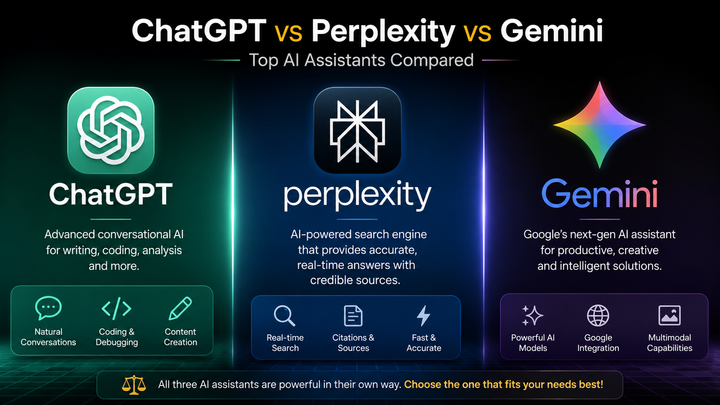
AI Chatbots Guide: Understanding ChatGPT, Gemini, Perplexity, and Modern AI Assistants
Artificial Intelligence (AI) chatbots are software systems designed to interact with users through natural language conversations. These systems use machine learning, natural language processing (NLP), and large language models (LLMs) to understand questions and generate responses.
Modern AI chatbots are increasingly used for information retrieval, content creation, productivity support, research assistance, education, customer interaction, and software development tasks.
Over the past few years, advances in generative AI have significantly improved the ability of chatbots to understand context, maintain conversations, and generate human-like responses.
Why AI Chatbots Matter Today
AI chatbots have become important digital tools because they help users access information quickly and efficiently.
Common use cases include:
- Educational assistance
- Research support
- Content drafting
- Language translation
- Coding assistance
- Knowledge discovery
- Productivity enhancement
- Business communication
Organizations, students, professionals, researchers, and content creators increasingly rely on AI-powered tools to support everyday tasks.
How AI Chatbots Work
Most modern AI assistants are built using Large Language Models (LLMs).
These systems typically process information through:
- Natural language understanding
- Context analysis
- Pattern recognition
- Machine learning algorithms
- Predictive text generation
- Continuous model improvement
When users submit a question, the AI analyzes the request, identifies relevant patterns, and generates a response based on its training and available information sources.
Popular AI Chatbot Platforms
Several AI chatbot platforms have gained significant attention in recent years.
| AI Assistant | General Focus |
|---|---|
| ChatGPT | Conversational AI and productivity |
| Gemini | Multimodal AI and information tasks |
| Perplexity AI | AI-powered search and research |
| Microsoft Copilot | Productivity and workplace support |
| Claude | Conversational reasoning and writing |
Each platform may emphasize different capabilities depending on its design goals and technology architecture.
Key Features of Modern AI Assistants
Most AI chatbots share several common capabilities.
These often include:
- Question answering
- Text generation
- Summarization
- Brainstorming
- Translation
- Research assistance
- Coding support
- Document analysis
Many systems also support multimodal capabilities, allowing users to interact using text, images, audio, and other formats.
AI Chatbots and Search Technology
One of the most significant developments in AI has been the integration of conversational interfaces with search technologies.
Modern AI assistants can help users:
- Explore topics
- Summarize information
- Compare concepts
- Generate explanations
- Organize research findings
This approach aims to simplify information discovery while improving accessibility.
Artificial Intelligence Technologies Behind Chatbots
Modern AI assistants often rely on several core technologies.
| Technology | Purpose |
|---|---|
| Natural Language Processing | Understanding language |
| Machine Learning | Pattern recognition |
| Large Language Models | Response generation |
| Neural Networks | Advanced computation |
| Generative AI | Content creation |
| Retrieval Systems | Information access |
These technologies work together to support conversational experiences.
Recent Industry Trends (2025–2026)
The AI industry continues to evolve rapidly.
Major developments include:
- Multimodal AI systems
- Real-time web integration
- Improved reasoning capabilities
- Enterprise AI adoption
- Enhanced security measures
- AI-powered productivity tools
- Personalized AI experiences
- Responsible AI initiatives
Organizations across many industries are exploring practical applications of AI technologies while balancing performance, reliability, and safety considerations.
Privacy, Security, and Responsible AI
As AI systems become more widely used, privacy and security considerations have become increasingly important.
Key topics include:
- Data protection
- User privacy
- Transparency
- AI governance
- Content safety
- Responsible AI development
- Information accuracy
- Security standards
Developers and regulators continue working to improve trust and accountability within AI ecosystems.
Laws and Regulatory Developments
Governments and regulatory bodies worldwide are developing frameworks to address AI-related issues.
Common areas of focus include:
- Consumer protection
- Data privacy
- Transparency requirements
- Algorithm accountability
- Intellectual property considerations
- AI risk management
Regulatory approaches continue evolving as AI technologies advance.
Tools and Educational Resources
Individuals interested in learning more about AI can explore various resources.
Useful tools and resources include:
- AI learning platforms
- Technology publications
- Research papers
- Prompt-writing guides
- AI ethics resources
- Machine learning courses
- Developer documentation
- Industry reports
These resources can help users better understand both the capabilities and limitations of AI systems.
Frequently Asked Questions
What is an AI chatbot?
An AI chatbot is a software application that uses artificial intelligence to understand user input and generate conversational responses.
What is a Large Language Model (LLM)?
A Large Language Model is an AI system trained on large amounts of text data to understand and generate human language.
Can AI chatbots replace traditional search engines?
AI chatbots and search engines often serve different purposes. Many modern systems combine conversational interfaces with search functionality.
What are multimodal AI systems?
Multimodal AI systems can process and generate information across multiple formats, including text, images, audio, and video.
Are AI chatbot responses always accurate?
No. AI-generated responses can sometimes contain inaccuracies or outdated information. Users should verify important information using reliable sources.
Conclusion
AI chatbots have transformed how people access information, complete tasks, and interact with digital systems. Through technologies such as natural language processing, machine learning, and large language models, modern AI assistants can support a wide variety of educational, professional, and research-related activities.
As AI technology continues evolving, chatbots are expected to become more capable, more personalized, and increasingly integrated into everyday digital experiences. Understanding the underlying technologies, industry trends, and responsible use considerations can help users make informed decisions about how these tools fit into modern workflows.
Disclaimer
This article is intended solely for informational and educational purposes. It does not promote, endorse, recommend, or compare any specific AI platform, software product, company, or technology provider. References to AI chatbots and related platforms are included only as examples to explain industry developments and technological concepts. The content should not be interpreted as technical, legal,financial, or professional advice.